Mickey Mouse stole our cultural legacy
My journey started with an innocent question. In 2002, a younger, more naive Jesse was enraptured by a new online encyclopedia that started gaining traction. It still had many placeholder articles, containing text copied verbatim from the 1911 Encyclopedia Britannica. 1911?, young naive Jesse wondered. That’s almost a hundred years ago! Surely there must be a more recent edition this so-called Wikipedia could crib from.
There was not.
Twenty-four years later, I write to you from the other side of a lifelong obsession with the public domain.
The public domain is best defined by the protection it lacks: copyright. Anyone can legally adapt, copy, or transform any public domain work for any reason. For example, Project Gutenberg can provide the full text of public domain books to everyone at no cost. Anyone can record and sell their own performance of public domain classical music. The omnipresence of Shakespeare and Brothers Grimm adaptations is partially due to their public domain status.
US law today stipulates any work created before 1931 is public domain. Fifty years ago, US law stipulated any work created before 1920 was public domain. Look how common reimagings of properties from before 1920 are as a result. Alternate takes on The Wizard of Oz (1900). The Cthulhu mythos (1919). Sherlock Holmes’s myriad incarnations (1887). Alice’s wonderland adventures (1865). The world is poorer for the 39 missing years copyright extensions have stolen from us. Instead of works from 1930, we could be in conversation with resonant works from 1969.
1969! Imagine what that would be like. In that world, anyone could make indie films starring the Joker as a trans woman without being ready for a multimillion-dollar lawsuit. Beatles cover albums could be as common as classical cover albums. Anyone could put their Kirk/Spock slashfic on bookstore shelves and auction off the movie rights. Casablanca might have a hit musical deconstructing it that goes on to inspire a series of two movies. Works like those are a part of our cultural background, and we should have a right to engage with them as we like.
How did it come to this? In 1842, Charles Dickens traveled across the US on a book tour. It was his first time visiting the country. The 30-year-old chronicled his strange experiences in the strange land in a travelogue, American Notes for General Circulation. He had yet to write his 1843 masterpiece, A Christmas Carol.
Dickens was confronted with cheap bootleg copies of his work everywhere. Flooded by requests to sign books he never saw any profit from, he testily wrote treatises arguing for international copyright law. Under the 1710 Statute of Anne, UK copyright law granted exclusive rights to publishers for 14 years from first publication, plus a 14-year extension on author request. US law was defined by the Copyright Act of 1790, ironically a near-verbatim copy of the Statute of Anne. To Dickens’s chagrin, neither law governed works created in other countries.
Dickens’s international copyright work culminated in the 1886 Berne Convention. That first international agreement established the norm of a 50-year copyright term. (The US agreed to its terms fashionably late, in 1988.)
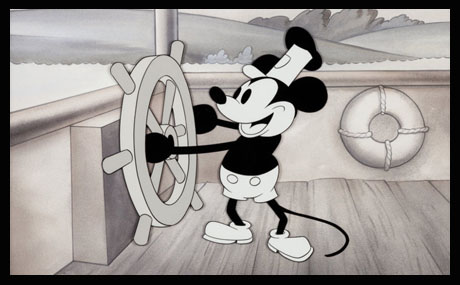 Animation cel from Steamboat Willie. A black-and-white Mickey Mouse cheerfully steers a boat down a river with a ship’s wheel. Notably, Mickey is not wearing his iconic gloves.
In the 1970s, Disney realized it had a problem. Steamboat Willie, the first animated short featuring Mickey Mouse, was from 1928. At that time, US copyright law protected a work for 28 years by default, plus a 28-year extension on request, for a total of 56 years. If Disney didn’t take drastic action, Mickey Mouse would enter the public domain in 1985, precipitating a company financial crisis. So Disney sent money through lobbyists to Congress, which was revising US copyright law to conform to the Berne Convention. The resulting Copyright Act of 1976 extended copyright protections by 19 years, to 75 years after date of publication. Works from 1918 entered the public domain in 1975. Works from 1919 entered the public domain in 1976. Works from 1920 would not enter the public domain until 1996. The mouse was safe.
In 1998, Disney did it again. They even had the nerve to deploy the name of Cher’s recently-deceased husband to gin up Congressional support for the Sonny Bono Copyright Term Extension Act. Its opponents called it the Mickey Mouse Act. 95 years after date of publication. Reader, I was furious to learn about this in 2002. Absolutely livid. Works from 1921 entered the public domain in 1997. Works from 1922 entered the public domain in 1998. Works from 1923 would not enter the public domain until 2019. That was unimaginably far in the future. I would be old by then!
Disney didn’t dare try a third round in 2018. 1998 was near the end of the era where they could do it without public outcry. The Internet and its post-scarcity information abundance had transformed the world. Works from 1924 entered the public domain in 2020.
2024 came and went without incident. 2022 had set a useful precedent, as A. A. Milne’s 1926 book Winnie-the-Pooh entered the public domain. People made distasteful works about the bear with very little brain (but without his iconic red shirt, a 1932 addition protected until 2028). But money continued flowing to the multimedia giant, which by then had purchased ABC, ESPN, Pixar, Marvel, Lucasfilm, and Fox. Similarly, no mousepocalypse occurred when works from 1928 finally entered the public domain in in 2024.
We have now celebrated Public Domain Day 11 times in the last 50 years, welcoming in works from 1920 through 1930. Here’s to the recently renewed prospect of public domain’s enrichment, at the rate of one year per year.
Experiments in self-medication
I’ve struggled with social anxiety my whole life. Fortunately, we have several OTC drugs for temporary anxiety relief, such as alcohol. Unfortunately, they all come with their own problems, such as hangovers. By default, I am a pretty inhibited, straight-laced, rule-follower. If you’re in a similar position, here’s what I’ve learned about taking advantage of anxiety relievers while limiting their side effects.
Alcohol: It feels dishonest not to talk about alcohol first. By far the most socially acceptable, to the point that teetotalling is regarded as weird. Alcohol absolutely does the thing people say it does. I have inhibitions that warn me not to do things because they might look stupid or inconvenience people. My experience is that alcohol makes those inhibitions much quieter. At the right dosage, they’re still present: I won’t humiliate myself or hurt people. But it brings their weight down closer to the average person’s. I also experience mild euphoria, a warm pleasant buzzing sensation.
The down sides are many! So many. Alcohol is really expensive. Alcoholic drinks are calorie-dense and not filling. Alcohol disrupts your sleep. I like its characterization as a “reverse nootropic” that takes effect the next day. I personally have the alcohol intolerance common among East Asians. My face doesn’t flush, but if I have more than two drinks, I’ll get a splitting headache within 20 minutes, definitively ending the evening’s merriment. I understand there are treatments that will address this disorder. I also understand that going over the right dosage, while literally painful for me, is debilitating for most people. When I tell people about my disorder, they sometimes express envy or tell me I’m virtuous somehow. So there are also treatments that will induce this disorder, if you want to enforce a screen-time-like limit to your drinking. I am happy with my current equilibrium.
As the omnipresent default option, alcohol is the yardstick against which anxiety relievers should be measured. ★★★☆☆
Marijuana: Recently legalized decriminalized, I haven’t experimented much with weed, on my psychiatrist’s recommendation. I have done the stereotypical thing of clearing my evening plans, taking gummies, and observing no effect. I have also done the stereotypical thing of taking slightly more gummies and having a wild brush with ego death that I’m glad I experienced once and would not care to repeat ever again. The one time I got the dosage right, I had a pleasant giggly dreamlike experience, but it didn’t feel like I was actually present for it. I’d prefer to have enough clarity to enjoy whatever’s happening. ★★☆☆☆
 Photo of a traditional Fijian method of kava preparation. The focus is a large metal urn of light brown liquid on an outdoor rattan floor. A sitting person with brown skin and red pants, face out of frame, mixes a drink vessel above the urn.
Kava: A traditional Polynesian social lubricant, rated about as addictive and safe as caffeine. I sought some out in Hawai’i, only to later learn there are more kava bars in NYC than there are in Honolulu. Under the influence of kava, I experience the same reduced inhibitions as with alcohol, but with more chill undertones. Like everything’s cool and I don’t need to do anything in particular. This is honestly the perfect effect to aid my quest to be a part of the masses, rather than apart from them. It tastes terrible (a friend reported, “Like something my grandma would make me drink”) and numbs my mouth and throat. Unfortunately, kava is easily confusable with kratom, a Southeast Asian stimulant rated about as addictive and safe as heroin. Kratom is illegal in most developed countries, but the US FDA refuses to regulate herbal supplements. So kratom is often on the menu right next to the kava. Not only is it sketchy to invite my friends to this extremely normal bar to try this totally safe drug I like, I have to strongly warn them against the other similar-sounding legal drug that the same place sells. I can’t give kava a perfect rating, because of how much courage and trust is required to set up a chat over kava in the first place. ★★★★☆
Tranquilizers: Xanax, Valium, et al. I don’t know of any OTC drugs in this family, so my experience is limited to the few times I’ve had them prescribed. Under Xanax, I experience everything as fine and cool, even things that would normally be upsetting. Then I have a deep, restorative sleep. Tranquilizers sound like great options in theory, but are limited by their lack of availability in practice. ★★★★☆
Caffeine: Don’t take caffeine to relieve anxiety. It makes it worse. Woe betide any hypothetical person with ADHD and social anxiety who self-medicates the ADHD with caffeine. Would not recommend. ★☆☆☆☆
Meditation: Not an external drug, but belongs on this list. As strange as it sounds, I had traumatic experiences with meditation as a kid. I wasn’t able to even consider meditating until my 30s. I only discovered my preferred method a few years ago, through personal experimentation and reading blogger trip reports. If you’d told me last year that diving deeper into meditation would permanently reduce my anxiety, I would not have believed you. So I don’t expect you to believe me. Just keep it in mind as something you can explore for yourself later. ★★★★★
Psilocybin: My lawyer has advised me not to comment on this drug while outside the state of Oregon.
Infinite Lives, 2024: Caves of Qud
Caves of Qud takes a premise I’d always daydreamed about and executes: what if you took a dungeon crawler, but instead of encountering increasingly powerful magic the further you explored, you encountered increasingly powerful technology? What kind of world would be required for that scenario to even make sense?
You can start with a toga, sandals, and a spear and pass through riot gear and assault rifles on the way to anti-gravity boots, spray-a-brains, and technology too distant and abstract to comprehend. Qud lets you experience fighting automated turret-building robots in carnivorous flower fields while wielding three broadswords and a katana. Oh, did I mention the modular body plans? You can play as an esper, mutant, cyborg, robot, flying dragon-snake thing, sentient crystal formation, giant slug, or all of the above.
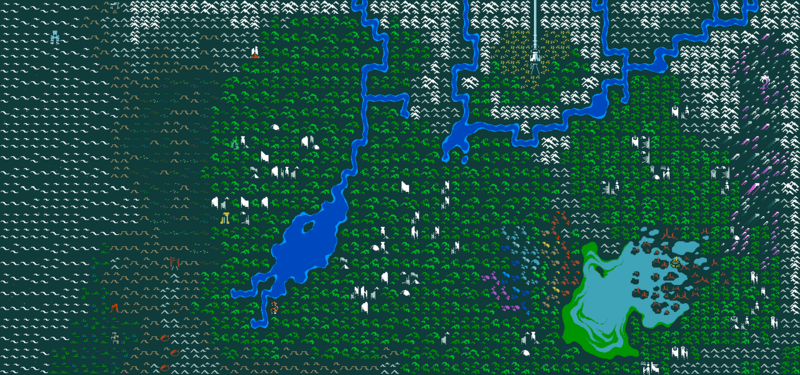 Screenshot of the world map in Caves of Qud. Ruined skyscrapers jut out of an overgrown jungle. Intriguing features like a lake made of something besides water, iridescent mushrooms, and a space elevator are scattered across the map.
How does Caves of Qud do these things when no other game ever has? One answer is, the developers spent more time on it than anyone else might reasonably expect. The game was in development for seventeen years. Another answer relies on their unorthodox decision to lean heavily on text. Caves of Qud has graphics, but they’re the tile-based icons common in traditional roguelikes. By relying on text to provide the detail missing from the tiny icons, the team gained the ability to quickly depict anything that they could describe. Traditional roguelikes are Qud’s closest relatives, specifically Tales of Middle-Earth Maj’Eyal (2012) and Ancient Domains of Mystery (1994).
Early in my time with the game, I’d scavenged up a musket and some chainmail, and was trading shots with sentient rock-throwing baboons amid red mesas. An errant rock missed me. I looked at it just in case.
Its description floored me. Larger rocks turn out to have descriptions that are just as poetic, but reading them had nowhere near the same impact on me. “It’s a sizeable piece of rock, older than every symbol.” “It’s a large piece of rock, older than every idea.”
Mechanically, what sets Qud apart from other roguelikes is the depth and variety of its systems. Like Disgaea (2003) and Monster Train (2020), Qud invites you to study and break its systems, then presents your delightfully broken builds with appropriately ridiculous challenges. To illustrate, one recurring enemy type is the jell. It’s first encountered as a giant amoeba that splatters slime everywhere when killed. Slippery and embarrassing but mostly harmless. Later on, black jells explode into raw sewage. Much later, purple jells bathe their surroundings in acid. Near the end, red jells erupt into sticky lava. At least nothing can possibly be worse than lava to make an endgame jell out of, you might think. Then you face zero jells that coat the world in warm static, which glitches out whatever it touches.
It’s a miracle that Caves of Qud was ever completed. It was a small studio’s passion project. They started working on it in 2007. It has been publicly playable since 2010. Sixteen years into development, they brought in Kitfox Games to lead the release. Kitfox had previously worked a similar miracle, guiding Dwarf Fortress (2022) to a full release after twenty years in development.
2024 felt like a breather year for video games, sitting between the goated 2023 and 2025’s embarrassment of riches. Balatro came out of nowhere to win awards and inspire an as-yet unnamed genre about adding roguelike elements to traditional games. Indiana Jones and the Great Circle was the archeologist’s best showing this century. Metaphor: ReFantazio showed the Persona 5 team could extend their stylishness to fantasy. And Animal Well set a new highwater mark for puzzle metroidvanias. But it was mostly a quiet year for big releases.
2048
Two hours into her investigation, the reality was unavoidable; Hazel was going to have to consult the splunk team. She facepalmed as she let out a frustrated sigh. The ticket had looked easy enough when she picked it up.
Hazel glanced at her time hud. 3:14 on Thursday. Blessedly little time before she could cast off the privilege and responsibility of being a verse fixer and just be for a few days. But whoever she ended up bothering would be annoyed about starting a big task just before the weekend. Splunkers had a reputation for spending all of their free time with their kids, and Hazel felt an involuntary twinge of guilt about pulling their attention away from that. She thought about calling it a day early, maybe halfheartedly dealing with emails before picking things back up on Monday.
No. She’d done that before. The unresolved problem would occupy her thoughts all weekend, casting a subtle gray dread on everything. Better to take care of it now.
She closed her left eye and sent off an immediate service request with splunk, feeling a little self-conscious. Hazel knew the eye-closing thing made her look like a clueless millennial, but she’d never gotten the hang of glance-typing. 140 wpm had been fast enough for her parents, and it would be fast enough for her.
Request confirmed. Hazel dismissed her monitor and started heading to the nearest elevator. The trip down was uneventful. She didn’t interact with splunk that often. Those programmers were all graybeards obsessed with life before the verse. Weirdos. She got off on 14, scanned in, and crossed into what they called the splunkers’ lair.
Blinking her left eye, Hazel noted Olivia Nguyen had accepted her request. She quickly memorized the route to Olivia’s desk before reopening her eye, flushing with embarrassment.
At least the system hadn’t given her someone new. Hazel had chatted with Olivia a few times and worked with them twice. Another unchead splunker, graying hair and forever lost in history. Olivia was old enough to grow up under the old net, before the verse took over. Old enough to have gone to college and gotten one of those 4-year degrees. They did at least genuinely enjoy splunking, so Hazel felt a bit better about imposing on their time.
Olivia greeted Hazel with an uncharacteristic grin. “Ooh, the deep systems this time! I haven’t dug around down there in months.”
Hazel involuntarily winced. “Yeah, I followed the issue back across the bridges to a core timing thing. This bug’s been around for twenty, maybe even thirty years. Glad to have your help.” She pulled up a chair at Olivia’s desk.
Olivia started hud-sharing as they navigated down through strata of code accumulated over decades. It was the first time Hazel had gone this far back. She vaguely recognized the bottom layer they’d arrived at as C++. Hazel’s eyes widened as she noticed a class name. She knew the verse had been called Fortnite back in the 10s, but hadn’t realized they kept the old name through most of the 20s.
Given some time, Olivia zeroed in on the problem and let out a knowing chuckle. “I should’ve known, it’s from back in the early agent days. See? Signed by Claude Code, April 2026. Broke this function when it was changing something else. Skill issue. Simple fix, really, but easy to overlook back then. I don’t think we’d even invented talents yet.” While Hazel chewed on the knowledge that the entire world had been slightly broken for longer than she’d been alive, Olivia put together a patch and kicked off the test batteries.
Another ticket closed, another tiny flaw smoothed out in the Epicverse underlying all of civilization. Hazel thanked Olivia for their help, congratulated them on a job well done, and started walking back to her desk. She tried to make her wink look casual. Her hud said 3:51. She’d finish up on time after all. Hazel smiled and started mentally planning out her weekend as she set her work blocks to expire in 10 minutes.
schmancy
The casual adjective schmancy first appears in a 1976 American newspaper, a clipping of fancy-schmancy. That particular form first shows up around 1935 and is obviously derived from fancy.
The posh adjective fancy is a generalization of the noun fancy from 1753. The passing desire fancy is in turn a contraction of the word fantasy from the late 1500s. The imaginary dream fantasy is a borrowing from Old French fantasie, probably some time in the 1300s. Fantasie is directly descended from Classical Latin phantasia, which is a borrowing from Ancient Greek φαντασία (phantasía), meaning “apparition”, in the BCE years. Φαντασία is derived from φαντός (phantós), meaning “visible”, sharing a root with φάος (pháos), meaning “light”.
As with other ancient words, we can compare it to similar terms like Sanskrit भास् (bhā́s), meaning “light”; Persian بامداد (bâmdâd), meaning “dawn” or “morning”; and Old High German bouchan, meaning and the ancestor of English “beacon”. Applying what we know about systematic sound changes over the past 6000 years lets us reconstruct a theroetical common ancestor, PIE bʰeh₂-, meaning “shine” or “glow”.
There’s a pretty wild set of more direct English descendants from the Latin and Greek branches of that tree, like photo, phosphor, emphasis, photon, and phantom. But wait, what was that bit about fancy-schmancy again?
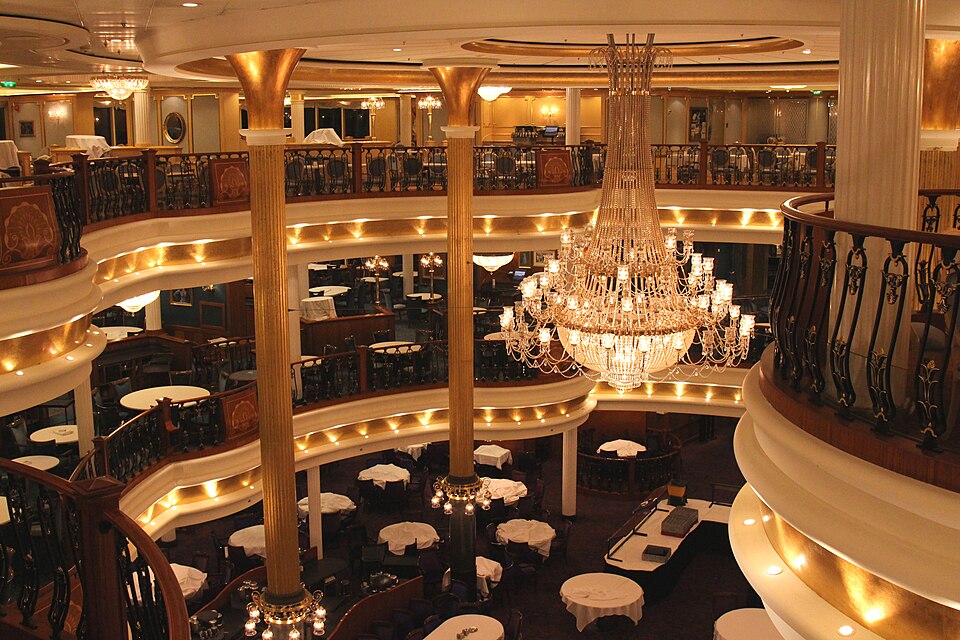 Photo of a fancy-schmancy multi-story dining room aboard a cruise ship. A central chandelier warmly lights the many elegant balconies and tablecloths.
A massive wave of Jewish emigrants fled persecution in Germany and Poland in the 1920s and 1930s. The US in general, and New York City in particular, was a popular destination. During this period of close contact, American and NYC English borrowed a lot of words from Yiddish like schmuck, putz, schlong, and some words that don’t mean “penis”. Some of those borrowings retain a whiff of their New York roots today, like schlub and schlep. The language contact in that period was so intense that English even borrowed a grammatical feature from Yiddish, a historical rarity.
Shm-reduplication is a construction used in English and Yiddish to indicate irony, skepticism, or derision. The archetypal example I reach for is “Consequences, schmonsequences”, but usages like “waiter, schmaiter” and “discount, schmiscount” feel plenty natural. Schm- is extra unusual in its role of a productive English duplifix. That is, you can apply it to words no one has applied it to before and expect to be understood, like “rizz, schmizz” or “Spiderman, Schmiderman”.
It’s a specific example of the more general linguistic phenomenon reduplication, where repeating an utterance changes its meaning. Some English examples include “yeah, yeah”; “like like” (as in, “do you like like him”); and “hear, hear”. Onomatopoeiac words like “blah, blah” and “choo-choo” seem especially open to reduplication. It’s more common in other languages, often taking on grammatical roles like pluralization or intensification.
In English, it’s more typical to find ablaut reduplication, where the vowel changes, rather than repeating an exact copy. You can determine specific patterns about which vowels can work this way. Rather than giving the specifics, I think it’s more fun to give a bunch of examples (and invite you to come up with your own) and see what you can see.
- dingdong
- zigzag
- crisscross
- tip-top
- knickknack
- chitchat
- tic-tac-toe
- bing-bang-boom
Now you know something about English that you knew but didn’t know you knew!