schmancy
The casual adjective schmancy first appears in a 1976 American newspaper, a clipping of fancy-schmancy. That particular form first shows up around 1935 and is obviously derived from fancy.
The posh adjective fancy is a generalization of the noun fancy from 1753. The passing desire fancy is in turn a contraction of the word fantasy from the late 1500s. The imaginary dream fantasy is a borrowing from Old French fantasie, probably some time in the 1300s. Fantasie is directly descended from Classical Latin phantasia, which is a borrowing from Ancient Greek φαντασία (phantasía), meaning “apparition”, in the BCE years. Φαντασία is derived from φαντός (phantós), meaning “visible”, sharing a root with φάος (pháos), meaning “light”.
As with other ancient words, we can compare it to similar terms like Sanskrit भास् (bhā́s), meaning “light”; Persian بامداد (bâmdâd), meaning “dawn” or “morning”; and Old High German bouchan, meaning and the ancestor of English “beacon”. Applying what we know about systematic sound changes over the past 6000 years lets us reconstruct a theroetical common ancestor, PIE bʰeh₂-, meaning “shine” or “glow”.
There’s a pretty wild set of more direct English descendants from the Latin and Greek branches of that tree, like photo, phosphor, emphasis, photon, and phantom. But wait, what was that bit about fancy-schmancy again?
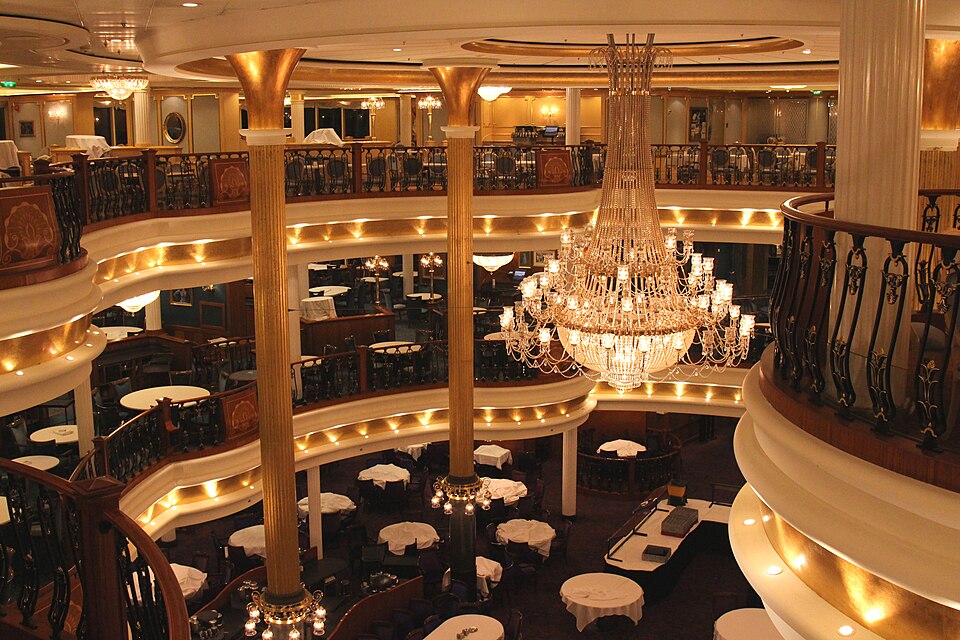 Photo of a fancy-schmancy multi-story dining room aboard a cruise ship. A central chandelier warmly lights the many elegant balconies and tablecloths.
A massive wave of Jewish emigrants fled persecution in Germany and Poland in the 1920s and 1930s. The US in general, and New York City in particular, was a popular destination. During this period of close contact, American and NYC English borrowed a lot of words from Yiddish like schmuck, putz, schlong, and some words that don’t mean “penis”. Some of those borrowings retain a whiff of their New York roots today, like schlub and schlep. The language contact in that period was so intense that English even borrowed a grammatical feature from Yiddish, a historical rarity.
Shm-reduplication is a construction used in English and Yiddish to indicate irony, skepticism, or derision. The archetypal example I reach for is “Consequences, schmonsequences”, but usages like “waiter, schmaiter” and “discount, schmiscount” feel plenty natural. Schm- is extra unusual in its role of a productive English duplifix. That is, you can apply it to words no one has applied it to before and expect to be understood, like “rizz, schmizz” or “Spiderman, Schmiderman”.
It’s a specific example of the more general linguistic phenomenon reduplication, where repeating an utterance changes its meaning. Some English examples include “yeah, yeah”; “like like” (as in, “do you like like him”); and “hear, hear”. Onomatopoeiac words like “blah, blah” and “choo-choo” seem especially open to reduplication. It’s more common in other languages, often taking on grammatical roles like pluralization or intensification.
In English, it’s more typical to find ablaut reduplication, where the vowel changes, rather than repeating an exact copy. You can determine specific patterns about which vowels can work this way. Rather than giving the specifics, I think it’s more fun to give a bunch of examples (and invite you to come up with your own) and see what you can see.
- dingdong
- zigzag
- crisscross
- tip-top
- knickknack
- chitchat
- tic-tac-toe
- bing-bang-boom
Now you know something about English that you knew but didn’t know you knew!