Infinite Lives, 1986: Arkanoid
The premise was clear, tried, and true. Break all the blocks. Ten years ago, Breakout (1976) created a hit by putting the Pong (1972) paddle on the bottom of the screen and giving people a crumbling wall to play against for when they couldn’t find a friend.
Imagine if we took everything we’d learned about video game design in the last six years - powerups, level design, destructible interfering enemies, and even a final boss - and applied it on top of an existing breakout hit? Oh, and let’s follow industry trends by making the player a spaceship and putting it in space.
Breakout and Arkanoid also owe a debt to pinball. You keep a ball in play by interacting with it at the bottom of the playing field while aiming for different targets. You get just enough control over the ball to be frustrated when it doesn’t do quite what you want.
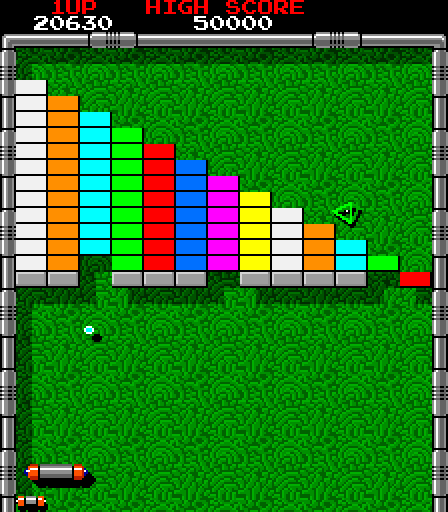 Screenshot of Arkanoid. The player controls a suspiciously paddle-looking spaceship in the lower left. Most of the screen shows colorful bricks arranged in a staircase pattern against an abstract green background. One enemy hovers menacingly, a green hollow tetrahedron with a shiny black core.
As common for 1980s games, the canonical version of Arkanoid is the arcade version. With memory measured in kilobytes, the extra power of a dedicated computer designed to play a single manifested as a big difference in quality. The version of Arkanoid I personally grew to love was not the arcade version, but the 1988 DOS port. Two additional years of exponential growth and a game that didn’t push the technical limits allowed for a fairly faithful port to home computers.
By 1986, arcade games were pretty evenly split between not including background music that blared through the ambient din, and a single catchy track for gameplay. Bubble Bobble (1986) and OutRun (1986) are remembered for their iconic background music, while Rampage (1986) and Arkanoid opted for the traditional minimalist approach that emphasized their sound effects.
Arkanoid was so influential that games that used to be called Breakout clones came to be called Arkanoid clones. Its storied brick-breaker battling progeny include the first Touhou game, Highly Responsive to Prayers (1997); FireStriker (1993); and my personal favorite, the arcade game Off the Wall (1991). Its influence eventually faded, with more recent brick-breakers like Odama (2006) and Yoku’s Island Express (2018) drawing inspiration from pinball instead.
Elsewhere in video games, 1986 notably saw the wide US release of the Nintendo Entertainment System, Nintendo’s rebrand of its Family Computer (Famicom) for overseas audiences. While it successfully sold through the 1985 holiday season, the console was only available in NYC at the time. The NES launched against a remarkably empty playing field. Burned by the 1983 crash, US companies largely saw video games as a fad whose time had passed.
While the NES became the standard bearer for video games in the US in the late 1980s, other countries embraced different ecosystems. Sony’s MSX personal computer saw success in its home country, but came to define that era of games in South Korea, Brazil, and Argentina. In the UK, Sinclair’s ZX Spectrum personal computer became the default game system, while its competitor Amstrad’s CPC found success in France, Spain, and West Germany. 1980s video games were unthinkably balkanized when compared to later eras.