Infinite Lives, 1990: Super Mario World
Super Mario World had impossibly big shoes to fill. Not just the direct sequel to megahit Super Mario Bros. 3 (1988), not just one of two launch titles justifying the purchase of a new ¥25,000 (roughly $470 equivalent) console, but also the first in a new era of video games where anything was possible and technical limitations were a thing of the past. Not only did Super Mario World successfully fulfill its expectations, it’s still commonly used as a creative canvas 35 years later.
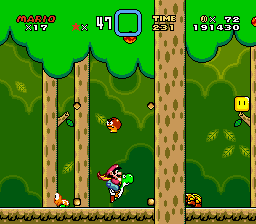 Screenshot from Super Mario World shown at double its native 256x224 resolution. Wearing a yellow cape, Mario is riding Yoshi in a dense forest, flanked by a hovering Goomba, a shell-less Koopa, and an obscured Wiggler.
Super Mario Bros. 3 was already a nearly perfect 2D platformer. What could Super Mario World add to make people to sit up and take notice? Levels could have secret exits, rewarding exploration with surprise and delight. You could replay levels, helping the world feel more like a world and allowing you to search for secrets at your leisure. Mario could already fly, but his new yellow cape boasted dynamic speed and altitude control. Most visibly, the Mario team had always wanted to have him ride a dinosaur, but weren’t able to make that work within hardware limitations until the Super Nintendo.
Super Mario World’s influence extends far beyond its initial release. It had a central role in the development of romhacks, where video game designers would replace the game’s data with their own levels. One Japanese romhack series, Kaizo Mario World (2007), inspired the category of extremely difficult “kaizo hacks”, and eventually the entire precision platformer genre. A tool-assisted speedrun demonstrated a crowd-pleasing arbitrary code execution exploit in 2014. Wilder still, a human-viable arbitrary code execution skipping to the credits was discovered in 2016.
Like many children’s properties, Super Mario World enjoyed a multimedia merchandising blitz that included comic books and a TV cartoon. The Mario Cinematic Universe became a childhood obsession for me. McDonalds tie-in? Weird cereal? Serial manga? Off-model trading cards? I was there for it, designing levels, drawing comics, and imagining extensions to Super Mario World and its tie-ins like Super Mario Kart (1992), Yoshi’s Cookie (1992), and Mario is Missing (1993). I dressed as Mario for Halloween in 1993. It’s hard to overstate its impact on my childhood.
There’s a tough tradeoff to make when categorizing games before 1995. Do you count the year a game was first released in any market, or just the US market? In this series, it makes more sense to count the first release in any market. This approach better showcases the gradual lifting of the era’s technological limitations. One caveat is that Super Mario World’s US influence is inextricably tied to the media landscape it released into in late 1991, not 1990. Another caveat is this series is a personal history, and my own stories about the game center around 1992, not 1990.
In the US, Super Mario World launched alongside Sonic the Hedgehog (1991). From our future perspective, we can assess that Mario’s fundamentals and continuous reinvention handily outpaced Sonic’s attitude and speed. Both hardware and game design needed to advance before Sonic’s core promise of full speed could be realized. That didn’t line up until as recently as Sonic Mania (2017). In contrast, Super Mario World is still the exemplar of a 2D platformer. Super Mario Wonder (2023) might do more things, do wilder things, and be more kid-friendly, but it isn’t fundamentally better at doing the thing that Super Mario World aimed to do. Anyway, this was all unclear at the time. The two mascots began a heated rivalry that only started dying down a generation later, with Mario & Sonic at the Olympic Games (2007).