Infinite Lives, 2024: Caves of Qud
Caves of Qud takes a premise I’d always daydreamed about and executes: what if you took a dungeon crawler, but instead of encountering increasingly powerful magic the further you explored, you encountered increasingly powerful technology? What kind of world would be required for that scenario to even make sense?
You can start with a toga, sandals, and a spear and pass through riot gear and assault rifles on the way to anti-gravity boots, spray-a-brains, and technology too distant and abstract to comprehend. Qud lets you experience fighting automated turret-building robots in carnivorous flower fields while wielding three broadswords and a katana. Oh, did I mention the modular body plans? You can play as an esper, mutant, cyborg, robot, flying dragon-snake thing, sentient crystal formation, giant slug, or all of the above.
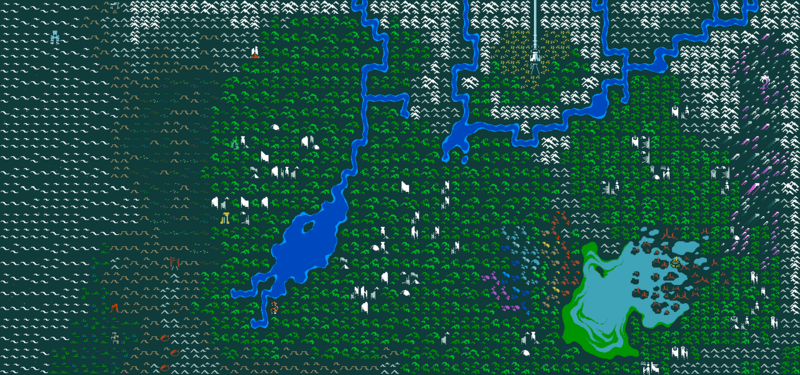 Screenshot of the world map in Caves of Qud. Ruined skyscrapers jut out of an overgrown jungle. Intriguing features like a lake made of something besides water, iridescent mushrooms, and a space elevator are scattered across the map.
How does Caves of Qud do these things when no other game ever has? One answer is, the developers spent more time on it than anyone else might reasonably expect. The game was in development for seventeen years. Another answer relies on their unorthodox decision to lean heavily on text. Caves of Qud has graphics, but they’re the tile-based icons common in traditional roguelikes. By relying on text to provide the detail missing from the tiny icons, the team gained the ability to quickly depict anything that they could describe. Traditional roguelikes are Qud’s closest relatives, specifically Tales of Middle-Earth Maj’Eyal (2012) and Ancient Domains of Mystery (1994).
Early in my time with the game, I’d scavenged up a musket and some chainmail, and was trading shots with sentient rock-throwing baboons amid red mesas. An errant rock missed me. I looked at it just in case.
Its description floored me. Larger rocks turn out to have descriptions that are just as poetic, but reading them had nowhere near the same impact on me. “It’s a sizeable piece of rock, older than every symbol.” “It’s a large piece of rock, older than every idea.”
Mechanically, what sets Qud apart from other roguelikes is the depth and variety of its systems. Like Disgaea (2003) and Monster Train (2020), Qud invites you to study and break its systems, then presents your delightfully broken builds with appropriately ridiculous challenges. To illustrate, one recurring enemy type is the jell. It’s first encountered as a giant amoeba that splatters slime everywhere when killed. Slippery and embarrassing but mostly harmless. Later on, black jells explode into raw sewage. Much later, purple jells bathe their surroundings in acid. Near the end, red jells erupt into sticky lava. At least nothing can possibly be worse than lava to make an endgame jell out of, you might think. Then you face zero jells that coat the world in warm static, which glitches out whatever it touches.
It’s a miracle that Caves of Qud was ever completed. It was a small studio’s passion project. They started working on it in 2007. It has been publicly playable since 2010. Sixteen years into development, they brought in Kitfox Games to lead the release. Kitfox had previously worked a similar miracle, guiding Dwarf Fortress (2022) to a full release after twenty years in development.
2024 felt like a breather year for video games, sitting between the goated 2023 and 2025’s embarrassment of riches. Balatro came out of nowhere to win awards and inspire an as-yet unnamed genre about adding roguelike elements to traditional games. Indiana Jones and the Great Circle was the archeologist’s best showing this century. Metaphor: ReFantazio showed the Persona 5 team could extend their stylishness to fantasy. And Animal Well set a new highwater mark for puzzle metroidvanias. But it was mostly a quiet year for big releases.