Infinite Lives, 1997: Star Fox 64
Fly a series of sorties against impossible odds as an ace fighter pilot with a team of wingmen. It’s a cliched scenario that had been done in a hundred games. Even in three dimensions, as early as Star Wars (1983). But to match the cliche with another, it had never been done as well as this.
Star Fox 64 came bundled with a Rumble Pak, plugging into the N64 controller’s expansion slot to provide force feedback for the first time for a console game. That controller fit your grip like an inverse glove, despite its three-pronged awkwardness. It’s clearer how natural it felt if you compare it to PSX and Saturn controllers. And while your wingmen embodied broad, conveniently animal-coded archetypes, they were memorable, bantered with you as you rescued each other, and fully voiced. All of that combined to create the most immersive experience available on a home console.
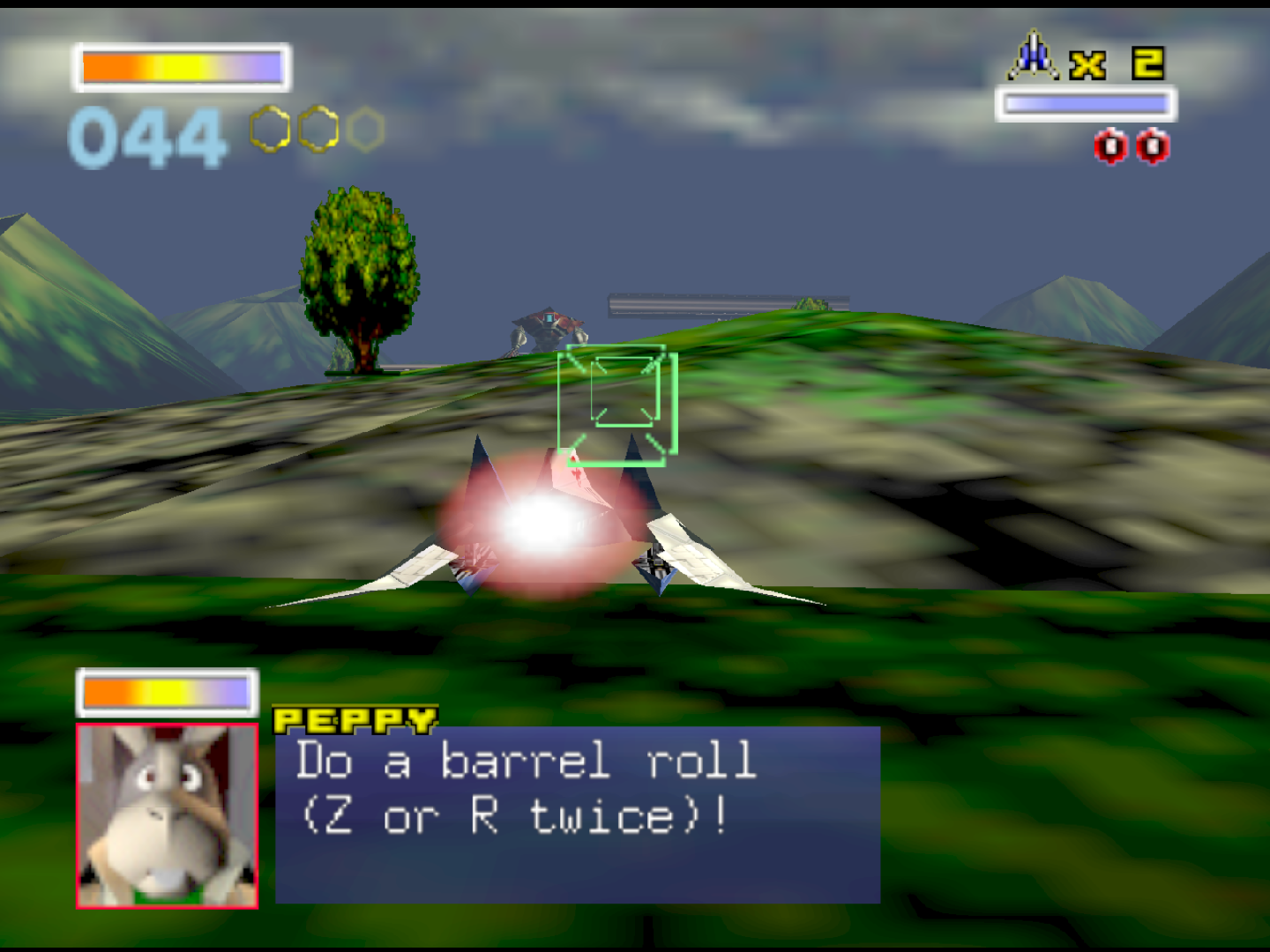 Screenshot from Star Fox 64. Fox’s starfighter Arwing hovers in the center of the screen over a lush green landscape representing Corneria. In a dialogue box that takes up the bottom of the screen, rabbit wingman Peppy advises Fox to do a barrel roll by pressing Z or R twice.
Star Fox 64 wasn’t just an arcade-quality experience you could play at home. You could play through it once in two hours to see a complete story. Or you could dig a little deeper and find three different campaigns that hidden sub-goals took you between. Every level of each campaign also featured strict scoring thresholds that rewarded mastery with medals. It was a calculated echo of the score attacks that defined 1980s shooters.
Nintendo’s Kyoto EAD division created Star Fox 64, including producer Shigeru Miyamoto and composer Koji Kondo. Both industry legends also worked on Star Fox (1993) and would go on to make Ocarina of Time (1998).
One interesting thing Star Fox 64 did was retread its predecessor’s story. It covered the same story beats Star Fox did, but with a level of detail infeasible just four years earlier. Nintendo had actually done the same thing already. EarthBound (1994) retold the same story that Mother (1989) did. The Switch 2 Star Fox (2026) plans to do it again, fleshing out Fox’s origin story with yet more detail and improved gameplay.
Star Fox 64 sits firmly in the rail shooter genre. Rail shooters are games like shoot-em-ups, but you take a set path into the screen, as opposed to right or up. Some early genre influences include Tempest (1981), Space Harrier (1985), and Panzer Dragoon (1995). The genre lost favor after the 1990s, when technological advancements made it cheaper to offer free movement in 3D space. This century, rail shooters are mostly limited to genre mashups such as Rez (2001), Child of Eden (2011), and New Pokémon Snap (2021).
You could describe 1997 as video game series figuring out how they could work in 3D, now that Super Mario 64 (1996) had shown it could be done masterfully. Final Fantasy VII (1997) made the transition masterfully, while GoldenEye 007 (1997) drew in console gamers with a taste of Quake (1996) LAN parties. Contemporary reviews panned Castlevania: Symphony of the Night (1997) for sticking with outmoded 2D. Sony even declined to market it, concerned the game looked too old-fashioned for the PSX. We only consider it the best-looking game that year in retrospect.