A brief history of time units: Hours
One writing project I want to spend time on at Inkhaven is a guided journey through the origins of the time divisions of a day. I’ve had the section on hours written up for months but never posted it publicly. On day -2 of Inkhaven, I’m taking another small step toward being more fearless about writing in public.
If space aliens showed up and compared notes with us, there are some concepts we think we’d share regardless of where they came from. Iron would still be iron, prime numbers would still be prime numbers, and so on. And seconds, minutes, and hours would seem like a weird arbitrary system. I thought your species had 10 fingers, what’s up with all the 12s?
So what is up with all the 12s, anyway? I decided to dig into the history of timekeeping to try and find out. We’ll go through the units from broadest and earliest, to finest and most recent.
Hours
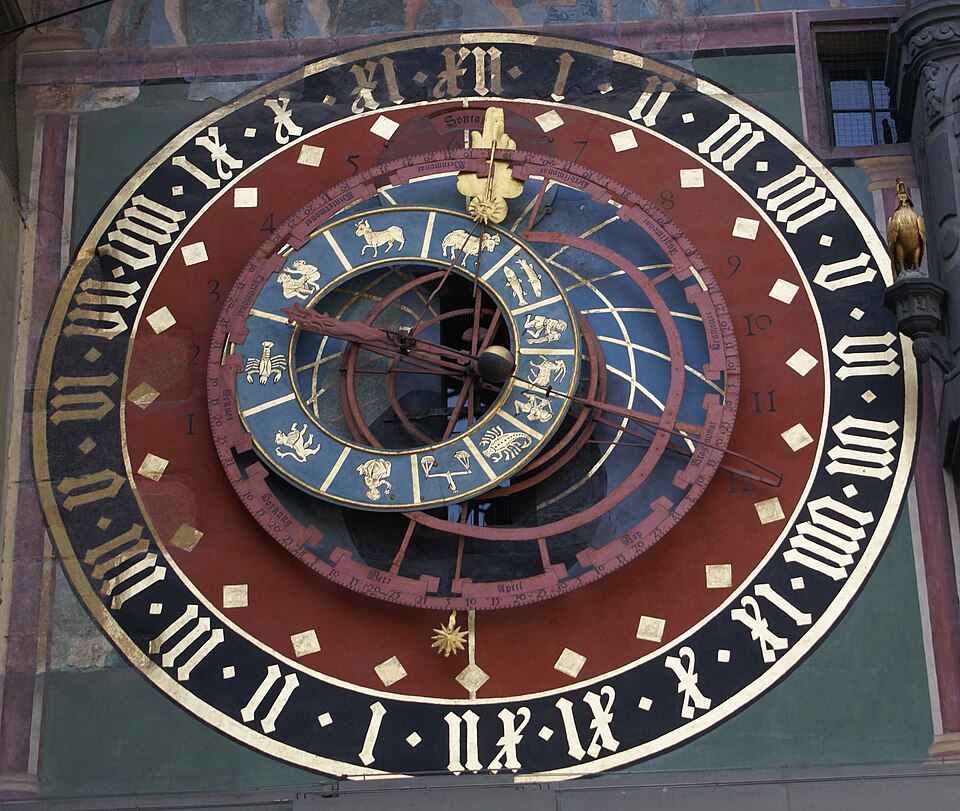 Photograph of an astronomical clock in Switzerland built perhaps around 1405. The clock only has an hour hand and Roman numerals from 1 to 12 twice going clockwise. Within the clock face is a smaller dial with the 12 zodiac animals and clockwork machinery in stark red, blue, and gold.
In the beginning, there was day and there was night. Influenced by 12 major constellations visible on the night of the annual flooding of the Nile, ancient Egyptians began dividing the night into 12 equal parts called wnwt around 2350 BCE. By around 1500 BCE, they’d extended the analogy to also divide the daylight hours into 12 different equal parts, measured with sundials.
So influenced, the classical Greeks also began dividing the day and night into two sets of 12 equal parts by around 150 BCE. Before that, the classical Greek day had 12 parts, but the night was divided into either 3 or 4 watches. While the word hour descends from classical Greek ὥρα (hṓrā), that word meant just “span of time” back then. The first clock that tracked hours across the full day-night cycle (νυχθήμερον, “nŭkhthḗmeron”) was constructed by Greek astronomer Andronicus Cyrrhestes around 50 BCE.
Of course, 24 hours were not the only top-level day divisions people came up with. Every major civilization had their own, from the 30 Vedic मुहूर्त (muhūrtaṃ) used from around 800 BCE to the 15 時 (shí) that divided up daylight hours in Han China by 139 BCE. Both Su Song’s 1094 CE water clock and Ismail al-Jazari’s 1206 CE programmable mechanical castle clock were the most accurate clocks in the world at time of construction. This particular history will focus on the ancestors and influences of the h:mm:ss system we use today.
Classical Greek and ancient Egyptian timekeeping both used unequal hours: one daylight hour wasn’t the same amount of time as one night hour. This is typical of timekeeping systems before the early modern era. In a world where lighting is smoky, expensive, and flickering, it’s more important to know how many hours you have until sunset, than it is to keep the length of an hour the same through the seasons. This only began to change when mechanical timekeeping became widespread. By 1400 CE, European cities began switching to “French” equinoctal hours so that they would only have to adjust the town clocks once a day, to correct drift, instead of twice a day, to change the length of the hour from day-hours to night-hours and back.