What does a newborn career look like?
As I stare down the barrel of an LLM-induced career change, I’ve been thinking about the lifecycles of careers themselves. When I was a kid, sysadmin was not a valid career option, let alone voice actor or 3D modeler. Meanwhile, technology disrupted how travel agents, accountants, and stock photographers work, but they persist nevertheless. Established careers we take for granted today, like scuba instructor, rocket scientist, and brain surgeon, didn’t exist 100 years ago. Where do new careers come from, and what does a newborn career look like?
I’m reminded of some advice for new grads I heard from a youtuber: look for things that weren’t possible ten years ago, things where established businesses will make it hard to get started ten years from now. That’s what a newborn career looks like. The way “youtuber” might have looked ten years ago. Doing things that make money, but aren’t seen as respectable yet.
How can you look for things that weren’t possible ten years ago? Technology may be the obvious answer, but it’s not the only answer. The way I try to go about it here is by noticing isolated, interesting trends and trying to draw connections between them.
 1902 print depicting many bizarre aircraft and their pilots in the skies above Paris. The title, “Le Sortie de l’opéra en l’an 2000”, meaning “Leaving the opera in the year 2000”, is displayed in the bottom center. The Eiffel Tower is faintly visible in the background in the left.
One need worth lots of potential revenue that’s currently unmet is immersive team-building experiences for corporations. In the last 15 years, we’ve seen the rise of people paying or traveling great distances to have novel experiences. Some examples include immersive theater, escape rooms, and large-scale larping. Many people are willing to go to great lengths to have novel experiences that are otherwise impossible.
Corporate team-building exercises have a long history. Trust falls and ropes courses have been corporate retreat cliches for longer than I’ve been alive. Axe throwing recently emerged as a more hipstery thing you can do as a team. I’m going to make a brave argument: team-building experiences don’t have to be bad. In fact, I will argue that they are better if they are good.
You could grow a business that fulfills this need by starting with a more appealing pitch: create a soulful experience that people would enjoy doing with their friends on a weeknight. Something interactive and immersive like an escape room, but incorporating some elements from immersive theater and larping that make those so compelling. If you succeed at this admittedly difficult goal, you can follow Slack’s customer acquisition model. The consumer product is the high-quality loss leader that generates word of mouth for the enterprise product, which is ten times more expensive for unspecified enterprise reasons. Today, corporate team-building budget is often devolved to individual teams in a show of autonomy. There are thousands of relatively naive purchasers inside each of those companies trying to spend money they’ll otherwise lose. It’s an ideal match for this type of guerrilla marketing.
If having to interface with corpos sounds too distasteful, there’s another business opportunity that still involves creating soulful experiences, but with a different business model. When I reflect on all the conferences, retreats, and classes I attended to learn something, the most successful ones featured experiential learning. They set up low-pressure situations where you can practice the thing you’re trying to learn under simplified, safe conditions. Then they give you free rein, letting you fail and try again until you figure out what works and why.
This is not far removed from unschooling models of child education like Montessori. Unschools are generally seen as effective, selective, and expensive. But what if you could get many of its benefits for a fraction of the time, money, and exclusivity? In the US, summer camp is an institution of upper-middle-class culture. You could create a week-long summer camp that specializes in experiential learning in a specific high-demand interest, like becoming an influencer or astronaut.
It might not even have to be a specific interest. Consider the recent success of adventure playgrounds and job-themed children’s amusement parks. Maybe a week where kids just get to decide what to do for themselves would be enough enticement.
One big challenge with this approach is assessment. It’s one thing to claim that experiential learning has been personally effective for me, but quite another to prove it shows up on standardized tests. You’d trade out the bugbear of working closely with corporations and corporate culture with the specter of working closely with schools and educator culture.
An understated benefit of life under capitalism is the comfort that I’m not the only one who can see these emerging trends. Other people chasing their fortunes have noticed them too. And I trust that if they’re actually viable, someone will figure out how to make them a reality, one way or another. One of those people’s stories and its associated fortune could be yours.
dashboard
The control center dashboard enters English in 1847 as a hyphenated compound of dash, here meaning “mud or water splashed up from moving quickly”; and the board that shielded a carriage driver from it. The protective board was in use before the word dash-board. People were calling it a splash-board in 1826. The compound word gradually lost its hyphen around the 1860s.
French engineer Émile Levassor invented the modern automobile in 1891. One of his innovations was moving the Daimler engine from the back of the car to the front. This opened up more room for passengers while also increasing the importance of the dashboard, which now also shielded the driver from the engine’s heat and oil spatter. As cars’ mechanical complexity increased over the next few decades, the dashboard’s location between the driver and the engine made it the natural place to add new gauges and controls.
The more recent semantic shift that generalized “the control panel for cars” into “the control panel for computers, or anything really” only started in 1990. The further shift to “data visualization hub” or “control center” began this century. Meanwhile, dashboard camera is from 1971. Its clipping dashcam first shows up in 1998.
 2006 photo of a softly glowing car dashboard. The prominent gauges are a tachometer on the left that includes a gear indicator, a speedometer displaying km/h in the center, and fuel and coolant gauges on the right. Most of the indicator lights are on.
Dash is regularly found by 1300, when we start seeing many more samples of written English. Arising from uncertain origins, we find cognates in some Germanic languages but not others. Its original sense was “strike”. One possible origin is an onomatopoeia dating to perhaps 1000 or 1200, inspired by words like clash, crash, smash, and bash. Dash picked up many different senses over the centuries. “Splash”, as seen in dashboard, is present by 1530. The punctuation symbol dash shows up in the 1600s. The nonviolent quick movement we typically associate with the word now is from 1796.
Board can be reconstructed back to Proto-Indo-European, over 6000 years ago. The word had a very different meaning then, perhaps “top” or “strike”. Its contemporary meaning “plank of wood” can be traced to Proto-Germanic, narrowing the shift to an unhelpfully vast temporal range of 2000 to 4000 years ago.
For a glimpse into a minor alternate universe, the American motorcar industry was not the only successful English-language auto industry in the 1910s. The US and UK industries thrived separately in an era when transatlantic communication was difficult and cumbersome. They naturally each developed their own sets of terms and jargon. For example, here are some consumer-serviceable car parts with two different, but still clearly English, names.
| enGB | enUS |
|---|---|
| accelerator | gas pedal |
| aerial | antenna |
| bonnet | hood |
| boot | trunk |
| cubby box | glove compartment |
| fascia | dashboard |
| indicator | turn signal |
| nave plate | hubcap |
| rev counter | tachometer |
| wing | fender |
This alternate universe is also visible through the pairs of terms that describe either motorcars’ internal mechanics, or the developing social rules around the novel act of driving.
| enGB | enUS |
|---|---|
| accumulator | battery |
| damper | shock absorber |
| estate car | station wagon |
| gearbox | transmission |
| give way | yield |
| lorry | truck |
| manual | stick |
| petrol | gas |
| puncture | flat tire |
| saloon | sedan |
| silencer | muffler |
| tickover | idle |
And then there’s a few small differences that provide local color, like how mathematics could be clipped to math or maths by default.
| enGB | enUS |
|---|---|
| brake lights | tail lights |
| car park | parking lot |
| demister | defroster |
| driving license | driver's license |
| gearstick | gearshift |
| number plate | license plate |
| tyre | tire |
| windscreen | windshield |
marathon
Considering its long history, the long haul marathon has an unusually short, well-defined history. The English word is a 1896 borrowing from French marathon, coined in 1894 by French linguist and marathon inventor Michel Bréal. Bréal was inspired by Pheidippides, a 1879 poem by English poet Robert Browning that retold the legend of the eponymous ancient courier. The poem established the version of the legend we tell today: a courier runs the 25 miles from Marathon to Athens to herald victory, then dies of exhaustion.
The story of Phedippides has some basis in history. Herodotus, writing around 440 BCE, describes a courier named Philippides at the 490 BCE Battle of Marathon. In that history, Philippides ran the 140 miles from Athens to Sparta in two days to call for reinforcements before the battle. The 25-mile run from Marathon to Athens and subsequent death from exhaustion originate from a different feat that Plutarch, writing over five centuries later, attributed to a runner named Eucles.
The Greek town of Marathon is named for the Ancient Greek word for fennel, μάραθον (márathon). It was likely borrowed into Greek from a local language that has been lost to history.
 Photo of the start of the 1896 Olympic marathon, in the Greek town of Marathon. About 50 men and several horses are lined up on a road in front of a large one-story building in the countryside. 8 children watch from the roof of the building.
Inspired by the ancient Olympic Games held every four years from 776 BCE until 393 CE, French aristocrat and historian Pierre de Coubertin founded the International Olympic Committee in 1890 to revive the quadrennial competition. The inaugural 1896 Athens Olympics lacked a headline event before Bréal suggested re-enacting the marathon run as a road race. The games and race were wildly successful, even attracting 14 athletes from the US. The marathon in particular was such a resonant idea that the annual Boston Marathon was held in 1897 and every year since (besides 2020).
The marathon’s status as the longest competitive distance inspired its metaphorical meaning of any really long event by 1909. -thon starts being used as a suffix with the same meaning in 1928 with walkathon. The first telethon was held in 1949; the first hackathon in 1985.
As with most international athletics, it was some time before distances and records were standardized. The marathon’s standard distance of 42.195 km (26.22 miles) was established in 1921 by measuring the course for the 1908 London Olympics. World records are now retroactively based on that distance, so the first marathon record time is 1908’s first-place time of 2:55:18. Over a century of accumulated improvements culminated in the first sub-2 hour marathon earlier this year, 1:59:30 by Kenyan distance runner Sabastian Sawe. That is over 26 consecutive miles at a sub-4:40 pace.
zero
The paradoxical quantity zero entered English in 1604 as a borrowing from multiple languages: French zéro (est’d 1485), Spanish zero (est’d 1512, now cero), and their shared source, Italian zero. Italian zero descends from Medieval Latin zēphirum, which Fibonacci coined in 1202 as a borrowing of Arabic صِفْر (ṣifr), meaning “empty”. ṣ-f-r is the Arabic stem meaning “void”. The Arabic word ṣifr was coined in 976 as a calque of Sanskrit शून्य (śūnya), which also means “empty” or “void”. Śūnya was the word for zero when it was first invented, which you could argue was either Pingala’s usage of it as a binary digit in the Chandaḥśāstra around 200 BCE, or the Lokavibhāga’s usage it as a place-value decimal numeral in 458 CE.
The numeral zero was in use in England before 1604. Before zero, the numeral was called nil, a borrowing from Latin nīl, a clipping of nihil, meaning “nothing”. Scores of zero are still often called nil in Commonwealth sports. And before nil, the numeral was called cipher, a 1399 borrowing from French cyfre, meaning “zero”. French cyfre was also borrowed from Arabic صِفْر (ṣifr), more directly this time.
How did cipher drift from “zero” to its current meaning? The original sense referred to both the quantity zero, and the numeral that represents zero. Within a hundred years, cipher picked up a related sense meaning “any numeral”. By the 1500s, this sometimes further extended to “any symbol”, before settling on “a code replacing symbols with other symbols”, which we can now imagine generalizing to today’s meaning.
The numeral zero was of course in use in England in 1600, because it is required to have a place-value numeral systems. In those, the value of a numeral is determined by its relative position, so the single symbol “2” could mean both two million or two thousandths, depending on where it is placed. England had gradually transitioned from Roman numerals to Arabic numerals over the past few centuries, because of how much easier calculations were in Arabic numerals.
Medieval Italians tried to make complex accounting work in their heritage Roman numerals. But as Venice, Genoa, and Florence developed the first complex European economies, their accountants also adopted Arabic numerals for ease of use. Their source was Fibonacci’s description in his Liber Abaci (Latin for “Book of Calculation”). Islamic accountants had similarly adopted a place-value numeral system for their own complex accounting centuries ago.
 Diagram illustrating the Brahmi numerals 1-9 and six of their descendants that influenced European digits, including Devanagari numerals and Western Arabic numerals.
In Arabic, the numerals we use in English are called “European digits”. They are descended from a specific variant of Eastern Arabic numerals that Fibonacci encountered in Algeria. All of the numerals saw wide regional and temporal variation before their modern forms were set in metal by the printing press in the late 1400s.
Earlier, I described Pingala as having invented zero, rather than having discovered it. Whether math is invented or discovered is an age-old inconclusive debate, but I lean toward math notation being invented, even if the concepts they represent were discovered. The symbol for zero seems to be a clear example of notation to me.
Infinite Lives, 1986: Arkanoid
The premise was clear, tried, and true. Break all the blocks. Ten years ago, Breakout (1976) created a hit by putting the Pong (1972) paddle on the bottom of the screen and giving people a crumbling wall to play against for when they couldn’t find a friend.
Imagine if we took everything we’d learned about video game design in the last six years - powerups, level design, destructible interfering enemies, and even a final boss - and applied it on top of an existing breakout hit? Oh, and let’s follow industry trends by making the player a spaceship and putting it in space.
Breakout and Arkanoid also owe a debt to pinball. You keep a ball in play by interacting with it at the bottom of the playing field while aiming for different targets. You get just enough control over the ball to be frustrated when it doesn’t do quite what you want.
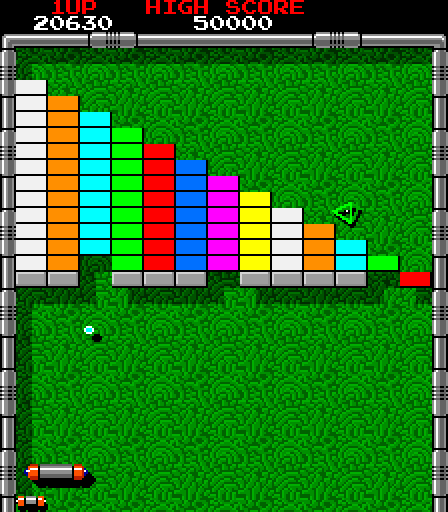 Screenshot of Arkanoid. The player controls a suspiciously paddle-looking spaceship in the lower left. Most of the screen shows colorful bricks arranged in a staircase pattern against an abstract green background. One enemy hovers menacingly, a green hollow tetrahedron with a shiny black core.
As common for 1980s games, the canonical version of Arkanoid is the arcade version. With memory measured in kilobytes, the extra power of a dedicated computer designed to play a single manifested as a big difference in quality. The version of Arkanoid I personally grew to love was not the arcade version, but the 1988 DOS port. Two additional years of exponential growth and a game that didn’t push the technical limits allowed for a fairly faithful port to home computers.
By 1986, arcade games were pretty evenly split between not including background music that blared through the ambient din, and a single catchy track for gameplay. Bubble Bobble (1986) and OutRun (1986) are remembered for their iconic background music, while Rampage (1986) and Arkanoid opted for the traditional minimalist approach that emphasized their sound effects.
Arkanoid was so influential that games that used to be called Breakout clones came to be called Arkanoid clones. Its storied brick-breaker battling progeny include the first Touhou game, Highly Responsive to Prayers (1997); FireStriker (1993); and my personal favorite, the arcade game Off the Wall (1991). Its influence eventually faded, with more recent brick-breakers like Odama (2006) and Yoku’s Island Express (2018) drawing inspiration from pinball instead.
Elsewhere in video games, 1986 notably saw the wide US release of the Nintendo Entertainment System, Nintendo’s rebrand of its Family Computer (Famicom) for overseas audiences. While it successfully sold through the 1985 holiday season, the console was only available in NYC at the time. The NES launched against a remarkably empty playing field. Burned by the 1983 crash, US companies largely saw video games as a fad whose time had passed.
While the NES became the standard bearer for video games in the US in the late 1980s, other countries embraced different ecosystems. Sony’s MSX personal computer saw success in its home country, but came to define that era of games in South Korea, Brazil, and Argentina. In the UK, Sinclair’s ZX Spectrum personal computer became the default game system, while its competitor Amstrad’s CPC found success in France, Spain, and West Germany. 1980s video games were unthinkably balkanized when compared to later eras.