Infinite Lives, 2000: Diablo II
Gradually build up a character from plinking away one shot at a time, to filling the screen with projectiles while blinking all over the map. Diablo II is all about experiencing an incredible 100-hour power fantasy character arc. Like with Lord of the Rings, playing it now can feel derivative rather than prescient, just because the series established so many of the conventions for video games. Red health and blue mana? Item sets? Teleporting to waypoints? Color-coded item rarities? Gems and socketable items? Item affixes? Skill trees??
One secret to Diablo II’s success was its obsession with procedural generation. Instead of static levels you could memorize, most Diablo II levels were randomly generated. While generated levels were a staple of the roguelike genre Diablo II descended from, they weren’t common in mainstream games. Diablo II’s world generation was notable in part for using many different generators based on your biome. Wandering the randomly-generated desert would feel very different from navigating abandoned sewers. While its predecessor Diablo (1996) was also procedurally generated, it contained a single 16-level dungeon, a pale shadow of Diablo II’s expansive generated world.
Diablo II inherited its rich, underexplored mechanics from Diablo, of course. Diablo was an attempt to take the roguelike Moria (1983) and add graphical, real-time action combat. Considered the first influential action RPG (ARPG), Diablo was a solid success. Its strategy of “take a niche genre that turbo-nerds love and make it pretty and legible to regular nerds” created an excellent foundation for Diablo II to expand on. Diablo II would then go on to inspire so many ARPGs that the genre is still sometimes called “diablolike” to this day.
Diablo-style item colors — blue for magic, yellow for rare, green for set, and gold for unique — would become the default for video games until its sibling World of WarCraft (2004) popularized its even more influential standard. ARPGs were such a compelling fusion that they still inspire entire new genres. Borderlands (2009) applied the formula to first-person shooters, creating looter-shooters. Vampire Survivors (2022) compacted the 100-hour character arc to 30 minutes, creating bullet heavens (or single-stick shooters, or pick-3s; the genre name hasn’t cleared its orbit yet).
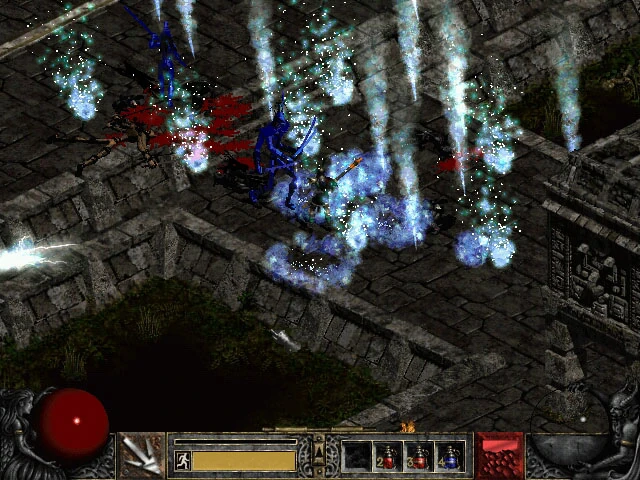 Screenshot of Diablo 2 in pixelated 640x480 resolution. A sorceress in trademark green casts Blizzard, spraying snow all over the dungeon and turning a nearby sword demon blue.
The Arreat Summit was an official Diablo II website where you could look up game mechanics in unprecedented detail. Official game websites in 2000 would have a screenshot or two, some marketing copy, and maybe a link to a fansite where the real information was if you were lucky. Allocating a website maintainer to publicly document the game’s inner workings was another thing Diablo II did far ahead of its time. Another was the free included netplay service battle.net.
I did not play Diablo II in 2000. Its system requirements included a ridiculous 32MiB of RAM. When they ran an open-to-everyone load test, I gave it a shot with my 16MiB of RAM and was treated to a slideshow. I could only look on in envy, only sneaking in a few hours on a friend’s gaming rig in 2001. I eventually learned how to physically jam some RAM I ordered straight from the manufacturer into my computer’s innards by 2002 and was able to enjoy it.
It would be negligent to discuss 2000 in video games without at least mentioning The Sims. The Sims was by far the most well-known game released that year, especially popular among people who didn’t play video games. Starting with SimCity (1989), Maxis set out to make games out of simulating everything from a single building in SimTower (1994) to the entire planet in SimEarth (1990). They’d known for years that simulated people would be the most difficult and rewarding game to get right. They managed to knock it out of the park, with innovations like the needs bars and mood framework that changed the way people thought. They even managed to include same-sex relationships, despite an unfriendly media climate.
Solar Revolution
Nearly 250 years on, the French Revolution’s legacy continues to underpin American culture. Liberty, freedom, and brotherhood! No kings! Actually, let’s kill all of the scientists! Men are born and remain free and equal in rights! The Statue of Liberty! The Louisiana Purchase! Optical telegraphs? Decimal currency: centimes and cents! Decimal units: meters and kilograms! Decimal time??
And while we’re remaking everything in the image of Reason, let’s throw out this ridiculous Gregorian calendar. Seriously, the 9th, 10th, 11th, and 12th months have been named 7 (septem), 8 (octō), 9 (novem), and 10 (decem) for thousands of years and no one has tried to fix it?! We can do better.
And so they did. The French Republican calendar features 12 months of 30 days each, plus five national holidays belonging to no month bringing the day count up to 365. Each month is divided into three décades of 10 days, with 9 days for work and 1 day for rest. (A reminder that the 2-day weekend was a more recent invention.) And the most exciting part: they got to name all the months, days of the décade, and days of the year from scratch.
Instead of venerating a tired Catholic saint, every day of the year would be named for a rural animal, vegetable, or mineral. The new month names would be neologisms themed on the weather in Paris, with rhyming names indicating each season. Beginning with late September-early August, the first month of autumn, they are: Vendémiaire, Brumaire, and Frimaire; Nivôse, Pluviôse, and Ventôse; Germinal, Floréal, and Prairial; and Messidor, Thermidor, and Fructidor. Rough literal English translations would be Vintagearious, Fogarious, and Frostarious; Snowous, Rainous, and Windous; Buddal, Floweral, and Meadowal; and Reapidor, Heatidor, and Fruitidor. An Englishman writing in 1800 instead offered the sublimely ridiculous: Wheezy, Sneezy, and Freezy; Slippy, Drippy, and Nippy; Showery, Flowery, and Bowery; Hoppy, Croppy, and Poppy.
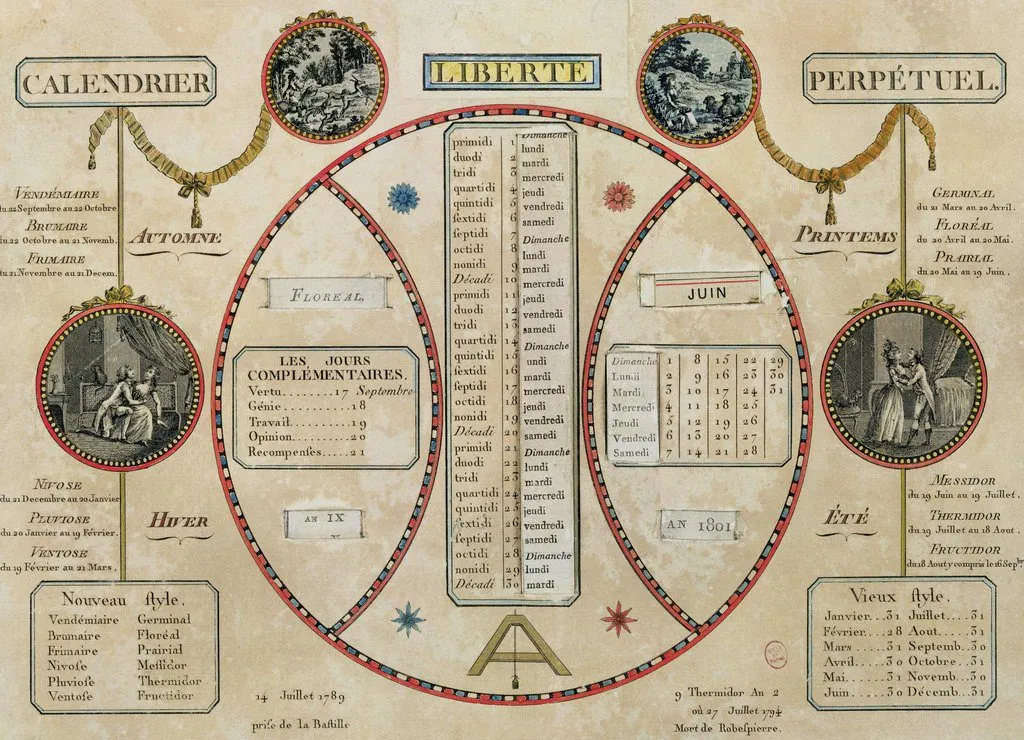 Scan of a French Republican calendar from around 1801, titled “Liberte”. Prominently visible are the current month and year; the day of the week associated with each date; and the equivalent Gregorian month, date, and year.
As it turns out, Napoleon abolished the Republican calendar a few years after he declared himself emperor. In the year 14 (1805), France returned to the loving embrace of the Gregorian calendar, save for a brief fling in 79 (1871) under the Paris Commune’s revolutionary government. Today, the calendar is mostly a historical footnote. Its most notable legacy is perhaps the name of the dish Lobster Thermidor, named for a play that was in turn named for the month of July-August.
Emperor Napoleon did not abolish people noticing the Gregorian calendar was stupid and designing replacements for it, which kept happening. What made the French Republican calendar unique was its official adoption as a national calendar. For example, the 1849 Positivist Calendar features months named Moses, Homer, Aristotle, Archimedes, Caesar, St. Paul, Charlemagne, Dante, Gutenberg, Shakespeare, Descartes, Frederick, and, uh, Bichat. Most notable calendar reform movements since then have, boringly but practically, stuck with the Julian month names. The postmodern 1963 Discordian Calendar specifies five seasons named Chaos, Discord, Confusion, Bureaucracy, and The Aftermath.
For more contemporary proposed month names, we have to look farther afield. Inspired by the Martian calendar used in Robert Heinlein’s 1949 science fiction novel Red Planet, aerospace engineer Thomas Gangale devised the Darian Calendar in 1985. A Martian year is 668 sols (or 686 Earth days) long, so the default (and difficult to ridicule) solution of using twelve existing names won’t work. Gangale’s proposal, named for his son Darius, opts for 24 months of 28 sols each, named for the twelve Zodiac constellations and their Sanskrit translations. If you’re familiar with Homestuck, you may notice something familiar about the Sanskrit months of Dhanus, Makara, Kumba, Mina, Misha, Rishabha, Mithuna, Karka, Simha, Kanya, Tula, and Vrishika. The Darian sols of the week, like the Julian and Gregorian day names, are based on the classical planets: Solis, Lunae, Martis, Mercurii, Jovis, Veneris, and Saturni.
Martian month names have been an inspiring creative outlet for many dreamers since 1985. It’s an awfully seductive question. What are twenty-four related names inspired by the future that you envision?
A brief history of time units: Seconds
This is part three of a multi-part series on the origins of the time divisions of a day.
[Part 1: Hours] [Part 2: Minutes]
Seconds
In 1707, four British warships miscalculated their position and ran aground off the Isles of Scilly, killing 2,000 sailors in what is still one of the worst maritime disasters in British history. For lack of a better approach, the way ships calculated their longitude at that time was dead reckoning, basically guessing how far they’d gone from the last known port. The disaster led to the Longitude Act of 1714, establishing a £20,000 (over £4M today) bounty for the deployment of a reliable way to determine a ship’s longitude within 30 minutes (half of a degree).
This is relevant to our history because one theoretical approach to determining longitude was to precisely measure the sun’s position and compare it to solar noon at a known location, such as the Greenwich Royal Observatory. If you knew the exact time, you could calculate your exact longitude from that single observation. The problem with this approach was, no one knew any way to get the exact time at sea. Our marvelous pendulum clocks wouldn’t work on the open ocean, because of the motion of the waves.
The problem lit a fire in the imagination of English clockmaker John Harrison, who presented his first prototype for a marine chronometer to the Royal Academy in 1730. A lifetime of iteration and experimentation resulted in his fourth attempt finally winning the prize in 1761. In its maiden test, his H4 chronometer drifted just 5 seconds over the course of an 81-day voyage, enabling a longitude measurement accurate within 1.25 minutes.
As alluded to earlier, the word second comes from classical Latin secunda, in particular its presence in the Latin phrase pars minūta secunda, meaning “second very small part”. We could have called minutes “primes” or “firsts” instead to maintain internal consistency, but that is not what we did.
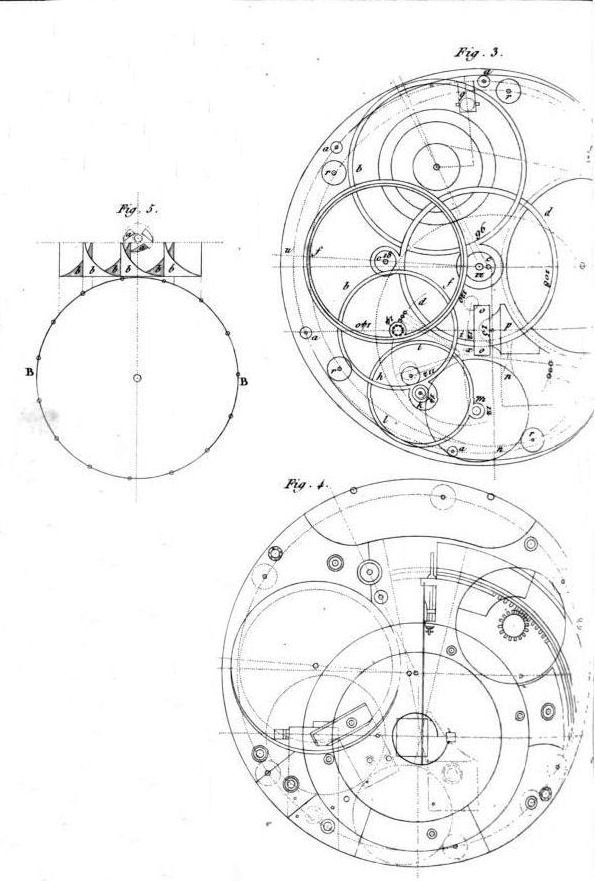 Scan of a diagram laying out the inner workings of the H4 chronometer. Several figures illustrating different cross-sections of the clock its mechanisms are labeled with letters.
The delicacy and expense involved in the construction of a device so precise made this solution barely affordable for even the richest country in the world. One chronometer cost one-third the price of an entire ship. Ordinary people wouldn’t have access to clocks with second accuracy until replaceable parts and manufacturing methods made them affordable in the mid-1800s.
The first implementation of the metric system, adopted by French revolutionaries in 1799, only covered base units of distance and mass (meters and kilograms), not time. Carl Gauss proposed using the second, to be officially defined as 1/86,400 of a day, as the standard metric unit of time in his millimeter/milligram/second measurement system in 1832. Over the next thirty years, his proposal found wide approval among scientists. The second was formally adopted as an official metric unit under the centimeter/gram/second measurement system, proposed in 1874 by a committee that included James Maxwell, Lord Kelvin, and James Joule.
Miniaturization followed mass production, resulting in the creation of pocket watches. Widely available second accuracy enabled new levels of coordination unviable just decades earlier. Military watches were first issued to officers in the 1880s. At the beginning of a battle, everyone would synchronize their watches to keep their maneuvers coordinated. In particular, it was important to agree on the exact second to expect an artillery strike. The phrase “synchronize your watches” is an artifact of the second era. You might not know the absolute time, but you could act like you did if you kept everyone’s relative times the same.
If you did in fact need to know the absolute time, observatories began broadcasting official time signals by telegraph in the 1850s. This wasn’t a service the average person would have access to. That begins with the 1924 appearance of radio time stations. Time hotlines that you could telephone for an accurate time signal started operating in 1933, gradually displacing the radio time stations.
Wristwatches, then called “bracelet watches”, were originally a women’s fashion accessory. They only lost their genderedness after military wristwatches entered common use around the world in the 1880s and 1890s. Newly verified as manly, men’s wristwatches became a standard fashion accessory in the 1900s. They remain the most popular men’s jewelry item to this day.
Clubs, really? That's what you call those?
What’s the deal with playing cards? From the perspective of someone learning about them for the first time, rather than something you’ve known all your life, they start to seem pretty weird. Clubs are clearly actually clovers, and spades look more like speartips. What’s a jack, and why is it on the same level as a king or queen? Earlier this year, I was surprised to learn that the last common ancestor of every tradition of playing cards was likely Chinese money cards in the 1300s.
In Xanadu did Kublai Khan the first national paper money decree. Chinese regional and national governments had tried to legitimize paper currency several times since Bi Sheng first invented movable type around 1044. The ability to cheaply print a different serial number on each banknote was the innovation that made this theoretically possible. Most of the earlier attempts to issue paper money had ended in either hyperinflation, or the entirely reasonable refusal to accept paper money over proper coinage due to hyperinflation. Kublai Khan’s 1260 decree finally resulted in the first time paper money was more widely circulated than coinage.
Like everything else, people found a way to gamble with paper money. But they also found it inconvenient and risky to play games with actual paper money. So some people printed up fake Monopoly money to gamble with instead. And some people came up with gambling games you could play with just the set of Monopoly money. The earliest one we have a record of is 馬弔 (mǎdiào), from the 1300s. A set of mǎdiào cards contains 38 cards in 4 suits:
- Cash, representing hundred-wen coins, numbered from 1 to 9.
- Strings of coins, representing thousands of 1-wen coins, numbered from 1 to 9.
- Myriads, representing 10,000s of wen, numbered from 1 to 9.
- Tens of myriads, representing 100,000s of wen, numbered from 2 to 9, plus three extra cards numbering 10, 100, and 1000.
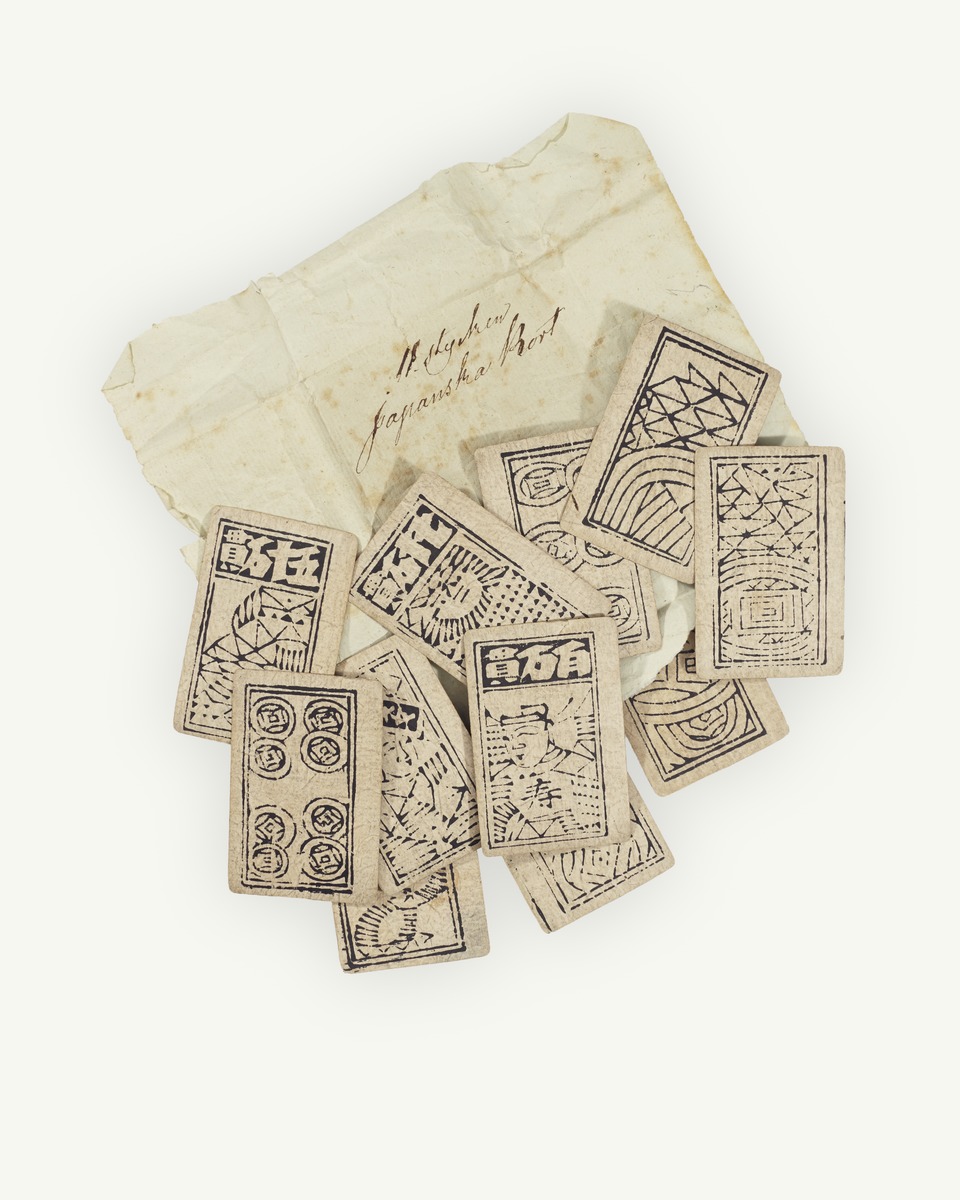 Photo of eleven madiao cards in front of a torn page incorrectly identifying them as “Japanese playing cards”. The cards are illustrated and printed in stark black on white.
This is clearly a direct representation of amounts of money. (Strings of coins, which had holes in the middle to facilitate this, were well known as the traditional way to carry large amounts of money.) You can find descendants of this groundbreaking deck in playing card traditions throughout Southeast Asia, as far off as Indonesia. The part that matters to our history of English playing cards is their spread west to the Kipchaks in central Asia. What later evolved into the Mamluk Egyptian tradition of playing cards featured the following suits:
- Coins, as the cash cards were illustrated with coins.
- Polo sticks, possibly the closest cultural referent to strings of coins?
- Cups, resembling the Chinese character for myriad (万) when seen upside-down. The name of the suit is the Turkic word for “myriad”.
- Swords
In the Mamluk deck, each suit contains 12 cards: ten of them numbered from 1 to 10, and face cards representing a king and a viceroy or deputy king. A third face card representing an under-deputy was added later.
By the late 1300s, we can tell that the Mamluk deck had spread to Eastern Europe and Islamic Spain by the presence of laws banning its use. Spanish playing cards descend from this tradition. They remain widely used throughout Central and South America. Spanish cards originally came in 52-card decks, but were later reduced to 48-card decks. They display the four suits of:
- Oros (coins)
- Bastos (clubs), the closest cultural referent to polo sticks
- Copas (cups)
- Espadas (swords)
The suits are numbered from 1 to 9, with the 10 later dropped for ease of printing. Each has three face cards, the rey (king), caballo (knight), and sota (page or squire). Notably, Spanish playing cards were the first variety to spread in England. When they were supplanted by French playing cards, the Spanish names for two of the suits stuck, clubs and espadas (spades).
By 1480, French playing cards had developed their own identity, influenced by the nearby German suits of leaves, hearts, bells, and acorns. The French suits drastically simplified the ornate illustrations found on German cards down to our familiar icons:
- Carreaux (tiles), from leaves
- Trèfles (clovers), from acorns
- Cœurs (hearts)
- Piques (pikes), from bells
The face cards here are our familiar king, queen, and knave (meaning “commoner”). In English, the knave was renamed the jack in 1864, as it was easier to distinguish K, Q, and J than K, Q, and Kn. Jack meant then what “guy” does now, a generic word for man.
Owing to their prevalence in the UK, US and Commonwealth, the English deck is widely known today. It is the ancestor of many newer playing card traditions. A notable exception is Japanese playing cards (hanafuda), also oddly not descended from the Chinese tradition, but instead based on Portugese playing cards in the late 1500s.
katsu
The culinary term katsu first appears in English, describing a style of curry, in 1976. Its standalone usage to mean just the cutlet begins much later, in 2006. It’s borrowed from Japanese カツ (katsu), meaning “cutlet”. カツ first appears in Japanese in 1928 as a clipping of カツレツ (katsuretsu), also meaning “cutlet”. カツレツ, in turn, first appears in Japanese in 1884, borrowed from English cutlet. Wait, what?!
The international expedition 岩倉使節団 (Iwakura Mission) was an 1871-1873 Japanese diplomatic voyage to Europe and the United States. Its primary goal, renegotiation of the unequal treaties forced on Japan at gunpoint, was not successful. Its secondary goal, learning more about industrialized societies to better enact Japan’s modernization, was wildly successful. One of those secondary results was the popularization of 洋食 (yōshoku), meaning “Western food”. トンカツ (tonkatsu), fried breaded pork cutlets, is regarded as one of the 三大洋食 (sandai yōshoku), meaning “three great Western foods”, dating to this period. The other two are curry rice and croquettes.
In 1852, US President Millard Fillmore assigned Navy Commodore Matthew Perry a mission to open trade with Japan by any means necessary. Since 1633, Japan operated under a policy of 鎖国 (sakoku), meaning “locked country”, closing its borders to expel foreign influence. In 1853, Perry sailed four steam-powered ironclads to the capital of Edo, firing blanks as a show of intimidation, while their iron hulls repelled all counterattacks. The Black Ships incident lives on in Japanese cultural memory as the paradigmatic out-of-distribution event: four invulnerable alien vessels arrive on the horizon, bearing unreasonable demands.
Katsu also has a Japanese homophone of much earlier origin, 喝. This sort of katsu is either a loud exclamation or a Zen Buddhist interjection for scolding. It’s akin to martial arts traditions’ 気合(kiai) shouted while performing an attack. 喝 is a borrowing from Chinese 喝 (hè, but pronounced xat in Middle Chinese), meaning “to shout”.
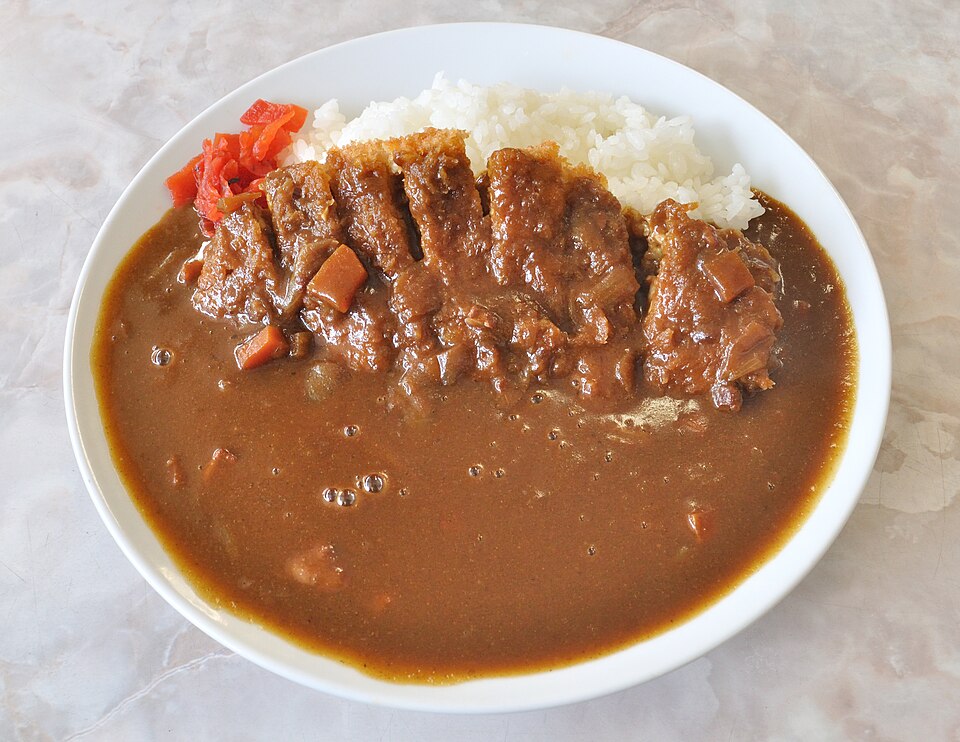 Photo of a katsu curry served at the Japanese equivalent of a diner. A sliced katsu cutlet, brown curry sauce, white rice, and bright red fukujinzuke are the prominent elements.
Anyway! The culinary term cutlet first appears in English, describing a cut of meat, in 1706. It’s borrowed from French côtelette, meaning “cutlet”. Côtelette, earlier rendered in Middle French as costelette, first appears in French in 1393 as a dimunitive form of Old French coste, meaning “rib” or “side”. Coste is a direct descendant of Classical Latin costa, meaning “rib”, which is of unknown origin. Notably, costa doesn’t have any historical connection to the word or meaning “cut”, with contemporary origin theories including a word that means “bone”.
Folk etymology led to the English spelling cutlet, as the relationship with a cut of meat seems obvious. (A cut of meat is named for being a piece cut from a larger whole, and starts appearing with that meaning in 1591.) Thanks to French, -let is conveniently also an English dimunitive, so a cutlet could be presumed to be named after a little cut of meat.
In 1706, cutlet referred specifically to a cut of veal. The term gradually expanded to encompass pork in the 1800s and chicken in the 1900s. The modern breaded and fried preparation is likely based on the Austrian dish Wiener Schnitzel, with additional influences from Italian and French dishes. Wiener is German for “Viennese”, its city of origin. Schnitzel is German for “cutlet”, with the perfectly parallel construction of Schnitz “a cut-off piece” from schneiden “to cut” + -el dimunitive. While we also sometimes call hot dogs wieners (or later, weenies), that is from a clipping of “Viennese sausage”.