DJ
The musician DJ is first seen in print in a 1948 issue of Billboard magazine as an abbreviation of disc jockey. Until around 1980, it was typically rendered D.J. to mark it as an abbreviation. The less common form deejay shows up a little earlier, in 1946.
The musician disc jockey is first seen in print in a 1941 issue of Variety magazine, combining the “driver” meaning of jockey with the disc storage medium of recorded music. Jockey started meaning “driver” in 1912 as a generalization of its “horse rider” meaning. Jockey has most commonly meant “horse rider” since the 1690s, a narrowing of its 1640s meaning, “person who works with horses”. Before picking up that meaning, jockey was a diminutive form of “Jock”, which was a Scottish variant of “John”, and referred generically to any young man.
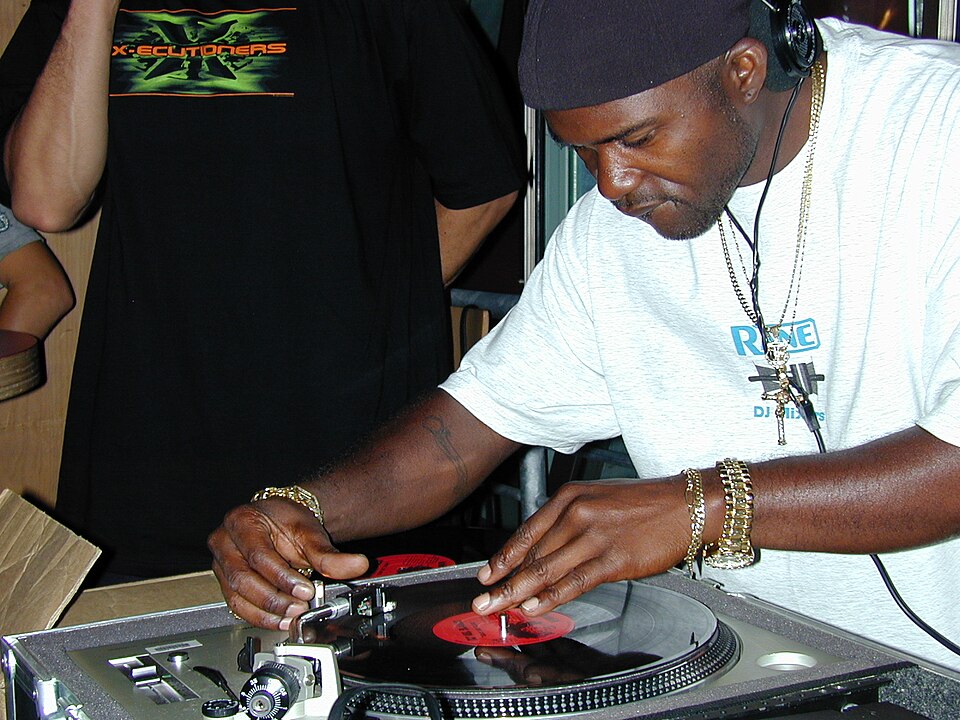 2002 photo of NYC-based DJ Grand Wizzard Theodore demonstrating the now ubiquitous DJ scratch technique that he invented in 1975. Theodore has brown skin and is wearing a black durag, light gray t-shirt, headphones, and gold jewelry. He is intently working a turntable.
The music storage medium disc is named for its disc shape. It appears as a synonym for record as early as 1879, at the dawn of recorded music. The shape disc goes back to the 1660s, describing the shape of a discus. It was either a clipping of discus, or a borrowing from Middle French disque. Discus can be traced all the way back through Classical Latin discus from Ancient Greek δίσκος (dískos), meaning “discus”. δίσκος originally comes from the verb δικεῖν (dĭkeîn), meaning “to throw”. (The suspiciously discus-shaped dish is also descended from Classical Latin discus, but through Germanic rather than French.)
The first fifty years of recorded music saw discs and cylinders compete for form factor. Discs gained their dominant majority in the 1920s, becoming synonymous with recorded music. You can track this through coinages. Discotheque is a 1929 borrowing from French. The word’s suffix comes from its original meaning of “music library”; bibliothèque is the French word for “library”. Discography first appears in 1930, with its contemporary meaning. Discophile shows up in 1932.
Even as discs’ material changed from wax to shellac to vinyl to plastic, the synecdoche endured. In the 1950s, the meaning of discotheque shifted to “club where music is played”, which was commonly clipped to disco by 1957. By 1966, the kind of music played at a disco was called disco music, like what we’d call dance music today. The emerging musical genre was named after disco music’s clipping to just disco by 1975.
Meanwhile, the storage medium’s American spelling disk took on fresh importance as they were repurposed for digital data storage. Disk drive is from 1952. The diminutive diskette was coined by IBM in 1973 to describe its tiny new 8-inch floppy disks. The decidedly less floppy hard disk also originates from 1973. Its data storage usages eventually died out in the 2010s. For portable data storage, they survived the transition from floppy disks to compact discs and even digital video discs. But SD card just stands for “Secure Digital card”. And for fixed data storage, hard disk drives gave way to solid-state drives around the same time.
Infinite Lives, 1997: Star Fox 64
Fly a series of sorties against impossible odds as an ace fighter pilot with a team of wingmen. It’s a cliched scenario that had been done in a hundred games. Even in three dimensions, as early as Star Wars (1983). But to match the cliche with another, it had never been done as well as this.
Star Fox 64 came bundled with a Rumble Pak, plugging into the N64 controller’s expansion slot to provide force feedback for the first time for a console game. That controller fit your grip like an inverse glove, despite its three-pronged awkwardness. It’s clearer how natural it felt if you compare it to PSX and Saturn controllers. And while your wingmen embodied broad, conveniently animal-coded archetypes, they were memorable, bantered with you as you rescued each other, and fully voiced. All of that combined to create the most immersive experience available on a home console.
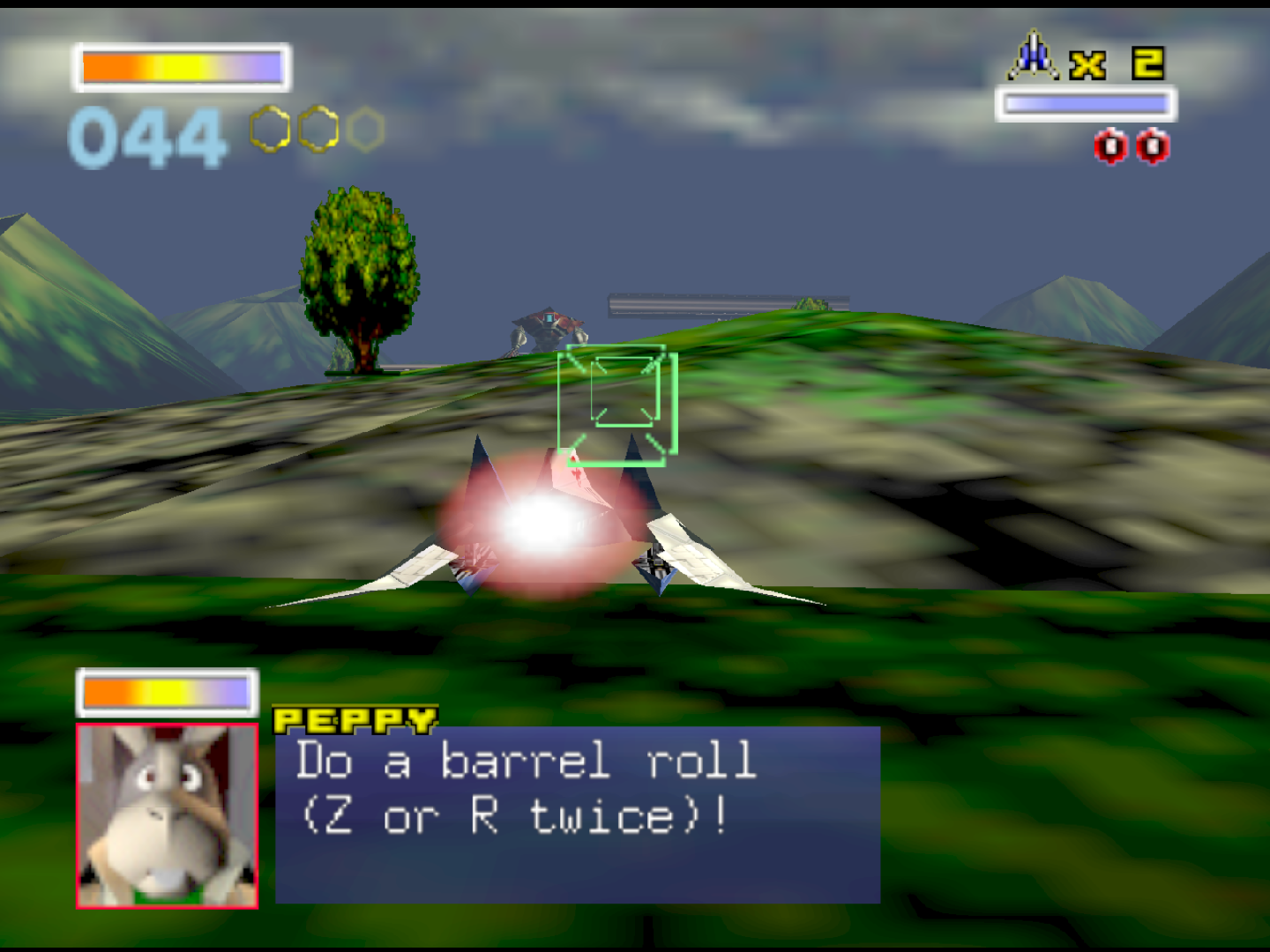 Screenshot from Star Fox 64. Fox’s starfighter Arwing hovers in the center of the screen over a lush green landscape representing Corneria. In a dialogue box that takes up the bottom of the screen, rabbit wingman Peppy advises Fox to do a barrel roll by pressing Z or R twice.
Star Fox 64 wasn’t just an arcade-quality experience you could play at home. You could play through it once in two hours to see a complete story. Or you could dig a little deeper and find three different campaigns that hidden sub-goals took you between. Every level of each campaign also featured strict scoring thresholds that rewarded mastery with medals. It was a calculated echo of the score attacks that defined 1980s shooters.
Nintendo’s Kyoto EAD division created Star Fox 64, including producer Shigeru Miyamoto and composer Koji Kondo. Both industry legends also worked on Star Fox (1993) and would go on to make Ocarina of Time (1998).
One interesting thing Star Fox 64 did was retread its predecessor’s story. It covered the same story beats Star Fox did, but with a level of detail infeasible just four years earlier. Nintendo had actually done the same thing already. EarthBound (1994) retold the same story that Mother (1989) did. The Switch 2 Star Fox (2026) plans to do it again, fleshing out Fox’s origin story with yet more detail and improved gameplay.
Star Fox 64 sits firmly in the rail shooter genre. Rail shooters are games like shoot-em-ups, but you take a set path into the screen, as opposed to right or up. Some early genre influences include Tempest (1981), Space Harrier (1985), and Panzer Dragoon (1995). The genre lost favor after the 1990s, when technological advancements made it cheaper to offer free movement in 3D space. This century, rail shooters are mostly limited to genre mashups such as Rez (2001), Child of Eden (2011), and New Pokémon Snap (2021).
You could describe 1997 as video game series figuring out how they could work in 3D, now that Super Mario 64 (1996) had shown it could be done masterfully. Final Fantasy VII (1997) made the transition masterfully, while GoldenEye 007 (1997) drew in console gamers with a taste of Quake (1996) LAN parties. Contemporary reviews panned Castlevania: Symphony of the Night (1997) for sticking with outmoded 2D. Sony even declined to market it, concerned the game looked too old-fashioned for the PSX. We only consider it the best-looking game that year in retrospect.
blog
The word for the thing you’re reading right now, blog, is first found in 1999 as a clipping of weblog. Some 1999 usages render it as ‘blog to mark the contraction. In spite of the 2001 dot-com crash, the term spread as rapidly as the phenomenon. In 2004, blog was Merriam-Webster’s second ever word of the year. The year before, rival American Dialect Society had highlighted blog as the word “most likely to succeed”.
A person who writes blogs has also been called a blogger since 1999. Blogger.com provided free blog hosting from its 1999 founding through its 2003 acquisition by Google. The sociological concept blogosphere was coined to describe this burgeoning “intellectual cyberspace” in 2002. By analogy, vlog, short for “video log”, first appears in 2002. Vlogs didn’t take off until YouTube provided free video streaming from its 2005 founding through its 2006 acquisition by Google.
Weblog was first used as a word in 1998. Web here is short for World Wide Web, named by Tim Berners-Lee during its 1991 invention. In the 1980s, the virtual world was often called the ‘net (short for Internet (short for inter-network)). When describing cyberspace, 80s and 90s science fiction invented fictional terms suggestive of nets, like matrix, web, and grid. Uncertain about the difference between the web and the internet and too afraid to ask at this point? I got you. The internet is the invisible utility grid that connects every computer in the world to every other computer. The web is the portion of that grid that you can access with any web browser and the right URL or search term.
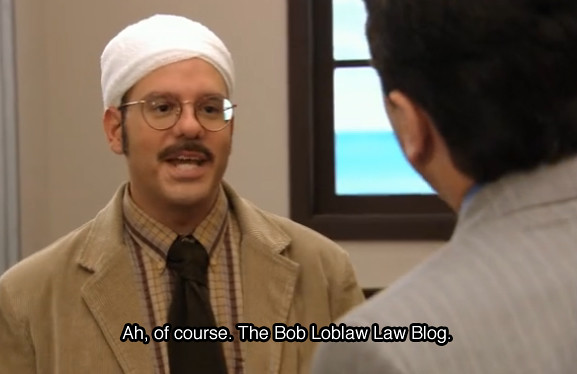 Screencap from “Making a Stand”, a 2005 episode of Arrested Development. A suited, bandanged Tobias, speaking to his lawyer Bob Loblaw and the camera, says the captioned line “Ah, of course. The Bob Loblaw Law Blog.”
An alternate form of weave, web has been the term for the object a spider weaves since before English existed. In the 1880s, we first see webbing metaphorically referring to a woven net. The food web describing species interdependence is from the 1930s. The 1994 coinage webcam generalized from “camera you can view on the web” to any camera connected to a personal computer. This is like the generalization of the 2004 coinage podcast, except that while we still use the web, we do not still use iPods.
Meanwhile, we’re not actually sure where log comes from. Log and its sibling-or-twin clog both start appearing in the late 1300s to describe felled trees. One wild guess is that clog is an onomatopoeia for the sound that a tree makes when you fell it, with log a derived clipping or regionalism. Clog eventually lost its original meaning of “log” to its relative, but not before generalizing in the 1400s to also mean either “wooden shoe” or “log attached to a prisoner to impede escape”, like today’s metaphorical ball-and-chain. The “impedance” meaning generalized to anything that slowed something down in the 1500s, then specifically gunk that impedes the passage of something in the 1740s.
Unlike its relative, log kept its original meaning of “log” to this day. It also started referring to a piece of wood for measuring a ship’s speed in the 1570s. To gauge your speed on the open ocean without any landmarks, you would throw the log overboard, wait a short time, estimate how far away it was, and reel it back in. By 1700, the thing you would record all the measurements in was called a log book. In 1825, we start seeing logbook clipped to just log, now meaning “journal”. Influenced by subsequent work-related usages like work log, logsheet, and change log, late 1900s programmers often called their journals “logs”. Specifically, American programmer Jorn Barger used this sense when he called his public journal a “Web log” in 1997. As its URL included “weblog”, American designer Peter Merholz facetiously rebracketed it as “we blog” in 1999, coining the term blog.
AV Club Classic – Tom Breihan’s The Popcorn Champs
For decades, the AV Club has fostered and hosted great entertainment journalism. So I find myself willing to forgive its organizational lapses. A recent annoyance is the removal of subcategories, making it difficult to read series that don’t have their own landing page.
As I compiled my list of inspirations for my Infinite Lives article series, which is half Tom Breihan by volume, I noticed how difficult it was to find his excellent 2019-2021 articles on the history of blockbusters, The Popcorn Champs. I also discovered The Avocado’s landing page addressing this problem with his earlier series A History of Violence. A small act of Internet archiving kindness that quietly makes the world a better place. Huh, that seems like something I could spend a little effort on too. So, without further ado:
The Popcorn Champs looks back at the highest grossing movie in America from every year since 1960. In tracing the evolution of blockbuster cinema, maybe we can answer a question Hollywood has been asking itself for more than a century: What do people want to see?
- 1960: Spartacus
- 1961: West Side Story
- 1962: The Longest Day
- 1963: Cleopatra
- 1964: My Fair Lady
- 1965: The Sound of Music
- 1966: The Bible: In The Beginning…
- 1967: The Graduate
- 1968: 2001: A Space Odyssey
- 1969: Butch Cassidy and the Sundance Kid
- 1970: Love Story
- 1971: Billy Jack
- 1972: The Godfather
- 1973: The Exorcist
- 1974: Blazing Saddles
- 1975: Jaws
- 1976: Rocky
- 1977: Star Wars
- 1978: Grease
- 1979: Kramer Vs. Kramer
- 1980: The Empire Strikes Back
- 1981: Raiders of the Lost Ark
- 1982: E.T. the Extra-Terrestrial
- 1983: Return of the Jedi
- 1984: Beverly Hills Cop
- 1985: Back To The Future
- 1986: Top Gun
- 1987: Three Men And A Baby
- 1988: Rain Man
- 1989: Batman
- 1990: Home Alone
- 1991: Terminator 2
- 1992: Aladdin
- 1993: Jurassic Park
- 1994: Forrest Gump
- 1995: Toy Story
- 1996: Independence Day
- 1997: Titanic
- 1998: Saving Private Ryan
- 1999: The Phantom Menace
- 2000: How The Grinch Stole Christmas
- 2001: Harry Potter And The Sorceror’s Stone
- 2002: Spider-Man
- 2003: The Return Of The King
- 2004: Shrek 2
- 2005: Revenge Of The Sith
- 2006: Pirates Of The Carribbean: Dead Man’s Chest
- 2007: Spider-Man 3
- 2008: The Dark Knight
- 2009: Avatar
- 2010: Toy Story 3
- 2011: Harry Potter And The Deathly Hallows: Part 2
- 2012: The Avengers
- 2013: The Hunger Games: Catching Fire
- 2014: American Sniper
- 2015: The Force Awakens
- 2016: Rogue One
- 2017: The Last Jedi
- 2018: Avengers: Infinity War
- 2019: The Lion King
- 2020: Bad Boys For Life
Infinite Lives, 1980: Rogue
Explore a deep dungeon of infinite possibilities where danger and treasure lurk around every corner. The dungeon is generated anew every time you play, so no two games will be the same. Discover troves of mysterious potions, scrolls, and wands that could be your salvation, or bear a horrible curse. The dangers are real enough to keep things tense. If you die in the game, your character is dead, with no undos, restore states, or load games. Time to roll up a new one.
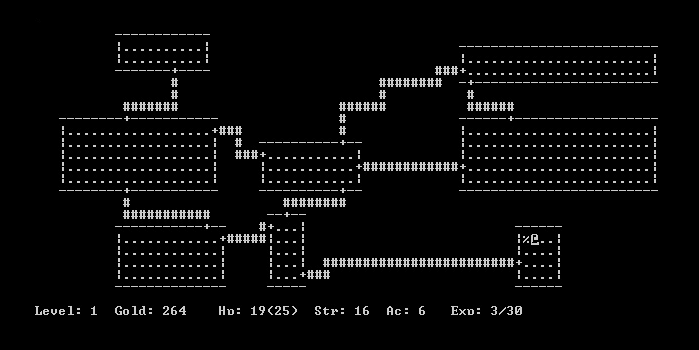 Screenshot from Rogue, which uses white on black text to approximate a top-down view of a dungeon level. The player, marked with an @, stands in a room connected to other rooms through dark tunnels denoted #, beside a staircase indicated by a %.
I have to confess, Rogue is the entry among these 50 I’m the least enthusiastic about. It was in fact popular and influential. Dennis Ritchie, co-inventor of Unix and C, joked that Rogue was the biggest waste of CPU cycles in history. But if you try to play it today, unlike its next-door neighbors Asteroids (1979) and Donkey Kong (1981), it’s difficult to learn and not very fun. Rogue’s distant descendant Dungeon Crawl Stone Soup (2006) does everything it set out to do, but better, besides just being easier to pick up and play. And you don’t have to look far to find a direct descendant that’s less obtuse but still influential enough to establish its own subgenre, such as Diablo (1997), NetHack (1987), Mystery Dungeon (1993), or Spelunky (2008).
So why did I choose to write about Rogue over another video game from 1980? Consider my second choice, Pac-Man. I run into all of the same issues with Pac-Man. It’s hard to overstate how popular and influential it was. It singlehandedly got everyone making and playing maze games like Rally-X (1980) and chase games like Dig Dug (1982). But its bootleg romhack Ms. Pac-Man (1982) is both ubiquitous and better in every way. And I’m young enough that my introduction to the series as a kid was Jr. Pac-Man (1983). I’ve enjoyed my time with Pac-Man’s descendants, but the game itself leaves me lukewarm.
Going down the list of the games released in 1980, I run into a similar lack of direct experience. I’ve played 20 minutes of Zork. Maybe 20 minutes of Missile Command. A few enjoyable hours of Rally-X, but not enough to wax poetic about it. Heiankyo Alien, Adventure, and Mystery House are all notable, but I’ve only read about or watched playthroughs of them. All told, the two hours I’ve actually spent with Rogue combine with my passion for its successors to render it the best option regardless. This particular year really runs up against my one game a year constraint. Getting a sense of what was going on with video games in 1980 still probably outweighs my lukewarm opinion of Rogue itself.
It is, however, possible to overstate Rogue’s influence on video games. Because it pre-dates all its notable siblings, it’s easy to claim Rogue as the originator of game tropes like experience levels and magic items. But those all stem from its main influence, 1974 tabletop sensation Dungeons & Dragons. When its fellow D&D descendants Wizardry (1981), Ultima (1981), Might and Magic (1986), Dragon Quest (1986), or Final Fantasy (1987) used those tropes, they weren’t copying Rogue; they were copying D&D. Rogue considered D&D’s six attributes and concluded the only one worth modeling was strength. It has to settle for merely naming the roguelike (and later roguelite) genres in addition to its admittedly gigantic influence.
Rogue’s monochrome text graphics imply the only way to tell different enemies apart is which capital letter they are. So I leave you with Rogue’s complete 26-monster bestiary, lifted wholesale from the 1977 D&D Monster Manual: giant Ant, Bat, Centaur, Dragon, floating Eye, violet Fungi, Gnome, Hobgoblin, Invisible stalker, Jackal, Kobold, Leprechaun, Mimic, Nymph, Orc, Purple worm, Quasit, Rust monster, Snake, Troll, Umber hulk, Vampire, Wraith, Xorn, Yeti, Zombie.