varsity
The level of competitiveness varsity was first applied to sports in 1891. Varsity is a clipping of univarsity, a regional pronunciation of university found in slang since the 1700s. The institution for higher education university was borrowed into English from Norman French université around 1300. Université is a direct descendant of Classical Latin ūniversitās, through Old French universitei and Medieval Latin universitas. Its Latin roots are ūni, meaning “one”; versus, meaning “turned” (later borrowed into English meaning “facing”, then “against”); and tās, a noun-forming suffix akin to the “ity” in “ability”. A thing turned into one. Classical Latin ūniversitās means “the whole” or “the entirety of”, as in the later borrowing universe.
How did a word that originally meant “the entirety of” come to mean a specific kind of institution for higher learning? The answer lies in the institution’s medieval European origins. Centers of higher learning have flourished since the Iron Age. The words we use to describe them today include the generic term school,
Madrasa (مدرسة) is the generic word for “school” in Arabic, derived from the root for learning D-R-S. Vihara (विहार) roughly means “monastery” in Sanskrit, though its original meaning was “inn” or “recreational center” 2300 years ago. Xué (學) is the generic word for “study” or “school” in Chinese, derived from a root meaning “awaken” or “gain awareness”. Academy (Ἀκαδημία) was the name of the person who owned the grounds the first academy was built on. Lyceum (Λύκειον) was an epithet of Apollo from a root meaning “light”, which came to represent a particular statue of Apollo, then the building where the statue stood. The Museum (Μουσεῖον) was a specific shrine dedicated to the muses.
In this context, it’s easier to place the university as the Christian equivalent of a madrasa or vihara. The first universities were cathedral schools or monastic schools before they became something different. The 1088 University of Bologna, 1096 University of Oxford, and 1150 University of Paris were officially certified as something different after a 1231 papal bull that established the university as distinct from the church. Its students nevertheless enjoyed clerical immunity to prosecution under civil law.
The oldest universities were not called that until the 1200s, as a short form of the phrase universitas magistrorum or universitas scholarium, meaning “encompassing all teachers” or “encompassing all schools”.
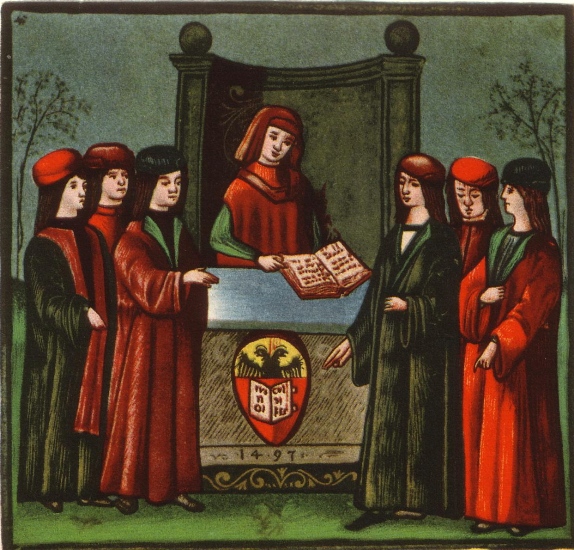 1497 illuminated illustration of students enrolling in the University of Bologna. Six long-haired students in green and red caps and robes stand outside, surrounding a desk and throne bearing the university seal. A robed person sitting in the throne writes in an open book.
500 years later, when English scholars sought to bring these traditions to North America, they felt their initial efforts were too feeble to warrant the term “university”. They used the word for a single department instead, college. The nine colleges established within the Thirteen Colonies were Harvard College in 1636, the College of William & Mary in 1693, the Collegiate School (now Yale) in 1701, the College of New Jersey (now Princeton) in 1746, King’s College (now Columbia) in 1754, the College of Philadelphia (now Penn) in 1740, the College of Rhode Island (now Brown) in 1764, Queen’s College (now Rutgers) in 1766, and Dartmouth College in 1769. Huh, why aren’t William & Mary and Rutgers grouped with the other seven today?
College became the English word for a single university department around 1400, through another borrowing from French. French college is directly descended from Classical Latin collēgium. Its Latin roots are con, meaning “with”; lēgō, meaning “appointed”; and ium, a noun-forming suffix. People appointed together. That makes sense; it’s the same root as colleague. So a college was a society of colleagues working toward the same goal. Or perhaps fellows.
In any case, in US English college stuck as the generic term for tertiary education, even as university accreditations became common in the late 1800s. So varsity sports became the term for intercollegiate competition. Junior varsity enters usage in 1902.
mesmerizing
The enthralling quality mesmerizing is first attested in 1829, as well as its base form mesmerize. The figurative usage of mesmerizing as an adjective for something spellbinding or transfixing begins appearing in 1846.
Today, we think of the verb mesmerizing as a synonym of hypnotizing. However, hypnosis was a later development. It was established in 1841 as a variation of mesmerism based on a different theory. Hypnosis was coined in French by mesmerist Étienne Félix d’Henin de Cuvillers in 1820 after Ancient Greek ὕπνος (húpnos), meaning “sleep”. It was first borrowed into English in 1841.
Mesmerism is based on the theory of “animal magnetism”, Lebensmagnetismus in the original German. Animal magnetism describes an invisible natural force common to all living things that can be manipulated with science. German doctor Franz Mesmer first wrote about the theory in a 1779 medical journal. It was not named after him until after his death in 1815.
For the first forty years, practitioners called themselves magnetizers. So what we now call hypnotists were typically called magnetizers from 1779 to 1820, mesmerists from 1820 to 1841, and hypnotists afterwards.
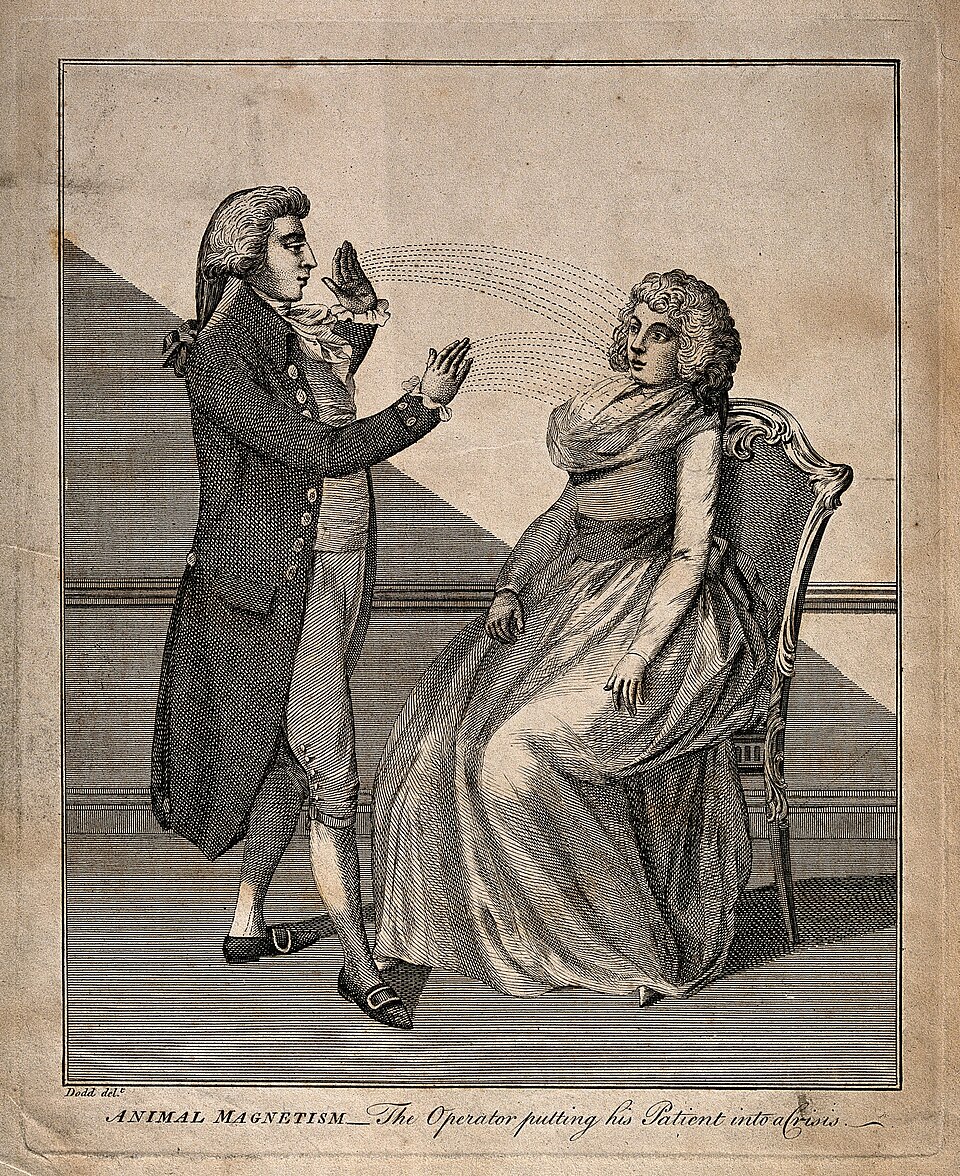 1802 engraving of a man mesmerizing a woman with animal magnetism. The man is wearing a powdered wig and a coat. He stands on the left and uses his arms to manipulate the life force. The woman is sitting in a fancy chair and wearing a long dress.
It’s worth noting that modern psychology was established in 1879. Before that, increased population density drove a need to isolate “insane” people in asylums for the good of society by the 1600s. Lunatics were typically treated as poor incurable wretches who needed to be confined, until the first more humane sanitarium was established in 1792. The English Lunacy Act of 1845 was the first legally mandate that mentally ill people be considered patients rather than prisoners, and treated appropriately.
Against this backdrop, the benefit of hypnosis as a possible treatment for mental illness where none existed makes more sense. Even if the theory didn’t pan out, the technique produced real benefits. You can see how Mesmer came up with the idea based on empirical results, absent any evidence to the contrary.
The German surname Mesmer originated as a variant of Messner or Mesner. Mesner can be traced back to Latin mānsiō (also the source of English mansion), meaning “dwelling”. It was an occupational surname for church officials in Austria and Bavaria, akin to English sexton. “Dwelling” here was presumably a metonym for church like in the phrase “house of God”.
Much MMORPG-specific slang originates from EverQuest, the 1999 game that established and codified the genre. In EverQuest, a key tool to manage incoming damage is the enchanter spell mesmerize. Likely inspired by the D&D spell fascinate, mesmerize prevents its target from acting until attacked. The specific spell mesmerize, and its inflicted condition mesmerized, came to represent the entire category of crowd control effects.
In the 2000s, it was common to refer to any “soft” crowd control that breaks when the target is hit with the clipping mez. (“Hard” crowd control is typically called stun.) A character that could mez was called a mezzer. The 2005 game Guild Wars played off this by calling its own enchanter class mesmer.
Twenty years later, the more generic term CC is more commonly used. “Mez” still sees occasional use, even in science fiction settings, or when the actual effect is more like sleep or freeze.
Infinite Lives, 2019: Heaven's Vault
Decipher an unknown ancient language through fragmentary inscriptions found on artifacts and monuments. As an archeologist from a culture where the concept of history itself is heresy, you stand entirely alone if you believe there’s anything to be gleaned from the past. But oh, how much there is to be gleaned. With enough linguistic understanding and attention to detail, you can piece together worldview-shattering revelations from the layered remnants of history.
Or, don’t do that.
Muddle your way through with educated guesses and trying buttons until something happens. History doesn’t care. The game doesn’t care. Your experience might be dramatically different, but the game is justifiably confident enough in its story to let things happen with or without your understanding.
 Screenshot from Heaven’s Vault. Two words in Ancient script are displayed with some possible glosses. Related words and their glosses are shown above. In the blurred background, the player character Aliya studies a weathered sheet of paper. Aliya is a woman of Middle Eastern descent in her 30s, wearing a loose headscarf and a tunic suited for fieldwork.
Focusing on the game’s reactiveness is kind of burying the lede. Heaven’s Vault is a game about translation. It is centered around a single twenty-hour series of logic puzzles about learning an unknown language. You spend most of your time figuring out what words might mean, negotiating with people to get more artifacts with language to analyze, and exploring unknown locations filled with even more tantalizing language. Getting access to new text is the reward for exploration and experimentation. If that speaks to you, this game is probably for you. And if it doesn’t, it probably isn’t.
Heaven’s Vault is simultaneously a personal story and a grand history. Events you learn about fill out a unified timeline that smoothly zooms from “I started this dig two weeks ago” to “I left the orphanage 20 years ago” to “The era I’m calling the Age of Sail for lack of a better name was 2000 years ago”. That zoomable timeline is one of the most prominent features in people’s memories of the game.
Heaven’s Vault is Inkle’s followup to their original debut 80 Days (2014), inspired by Jules Verne’s classic novel. Like 80 Days, Heaven’s Vault is a game with a pre-defined beginning and end, and an uncomfortably unknown middle. Unlike 80 Days, there is no map of the world to give you a sense of how far you’ve come and how much yet remains. In a feat yet to be matched, I found myself unable to determine what kind of structure the game had. What a delight to feel so lost despite all my genre-savviness.
Inkle plays to their experience with unknown middles in their subsequent games like Overboard! (2021) and Expelled! (2025). Their works can more generally be categorized as interactive fiction, or IF. Other contemporary studios exploring the IF space include Failbetter in Sunless Skies (2019) and Mask of the Rose (2023), and Choice of Games in Choice of the Deathless (2013) and The Luminous Underground (2020).
Maybe it’s more useful to categorize on a different dimension. Heaven’s Vault is a mystery game where you play the role of detective, a feeling games have tried to capture for decades. What distinguishes it from previous attempts like The Dagger of Amon Ra (1992) and The Last Express (1997) is how open-ended the mystery is. Historically, detective games like Ace Attoney (2001) and Danganronpa (2010) feature satisfying mysteries packed with wild aha moments that the game insists you unravel step by step at its pace, not yours. The new breed of mystery games heralded by Her Story (2015) and exemplified by Return of the Obra Dinn (2018) instead leave you to your own devices, letting the mystery sit in ambiguity until you work it out yourself. They feel much more like making brilliant deductions than painting in the numbers of a pre-outlined plot. Later games that build on this design innovation include Paradise Killer (2020), Pentiment (2022), and Rise of the Golden Idol (2024).
2019 is overstuffed with excellent games, any of which I could have chosen to praise enthusiastically here instead. Slay the Spire (2019) created a genre so rich that it inspired its own genres. Disco Elysium (2019) is a singular gonzo lightning-in-a-bottle masterwork. Outer Wilds (2019) created metroidbrainias and remains their unsurpassed exemplar. Baba is You (2019) perfectly executed a different impossible game concept. Untitled Goose Game (2019) caused problems on purpose, reaching far beyond video game fans. Mainstream releases similarly excelled with the likes of Control (2019), Final Fantasy XIV: Shadowbringers (2019), Fire Emblem: Three Houses (2019), Sekiro (2019), and Apex Legends (2019). I believe my personal favorite, Deadfire (2019), will remain unmatched in its genre through at least 2029.
None of those worthy entries affected me as deeply as Heaven’s Vault. Its themes, story, and mechanics became a part of me that will remain as long as I live. That’s why I wrote about it over another of these deserving titles.
prairie
The grassland prairie is a 1761 borrowing from Modern French prairie, meaning “meadow”. You can trace the word backwards through time, maintaining its meaning, through Old French praerie, Vulgar Latin prataria, and Classical Latin prātum. It refers to a specific kind of meadow often found in French Canada and Louisiana. Prairie dog is from 1804, the one survivor from a family of animal names that once included prairie lark, prairie mole, prairie fly, and prairie snake.
The majority of English geographical terms are as old as the language. But a significant plurality refer to features not found in the British Isles, but in the Americas. Those showcase a diversity of origin concentrated around a short time period that I enjoy.
The creek kills is a 1669 borrowing from Middle Dutch kill, with the same meaning. The Dutch term can be reconstructed back to Proto-Germanic kiljǭ, meaning “fissure”.
The cliff face bluff is a 1687 coinage based on the obsolete nautical term bluff, meaning “having a broad, flattened front”. It was originally used to describe a cliff formation found in the American Colonies.
The grassy plain savanna is a 1697 borrowing from Spanish sabana, with the same meaning. The Spanish term is a borrowing from Taíno zavana.
The mountain chain cordillera is a 1704 borrowing from Spanish cordilla, a diminutive of cuerda, meaning “rope”. It is a synonym of sierra. The Spanish term is a direct descendant of Classical Latin chorda, meaning “intestine” or “cord”, itself a borrowing from Ancient Greek χορδή (khordḗ), meaning “guts”.
The descriptive wetland is a 1743 compound originally used to describe a type of land found in the American Colonies.
The rough section of a river rapids is a 1744 coinage based on rapid. It originally described sections of rivers found in New York.
The small island cay (or sometimes key) is a 1761 borrowing from American Spanish cayo, with the same meaning. The Spanish term is a borrowing from Taíno cayo, meaning “small island”.
The marshy waterway bayou is a 1766 borrowing from Louisiana French bayou, with the same meaning. The French term is a borrowing from Choctaw bayuk, meaning “creek”.
The river embankment levee is a 1770 borrowing from Modern French levée, with the same meaning. The French term is a coinage based on lever, meaning “to raise”, directly descended from Classical Latin levāre, also meaning “to raise”.
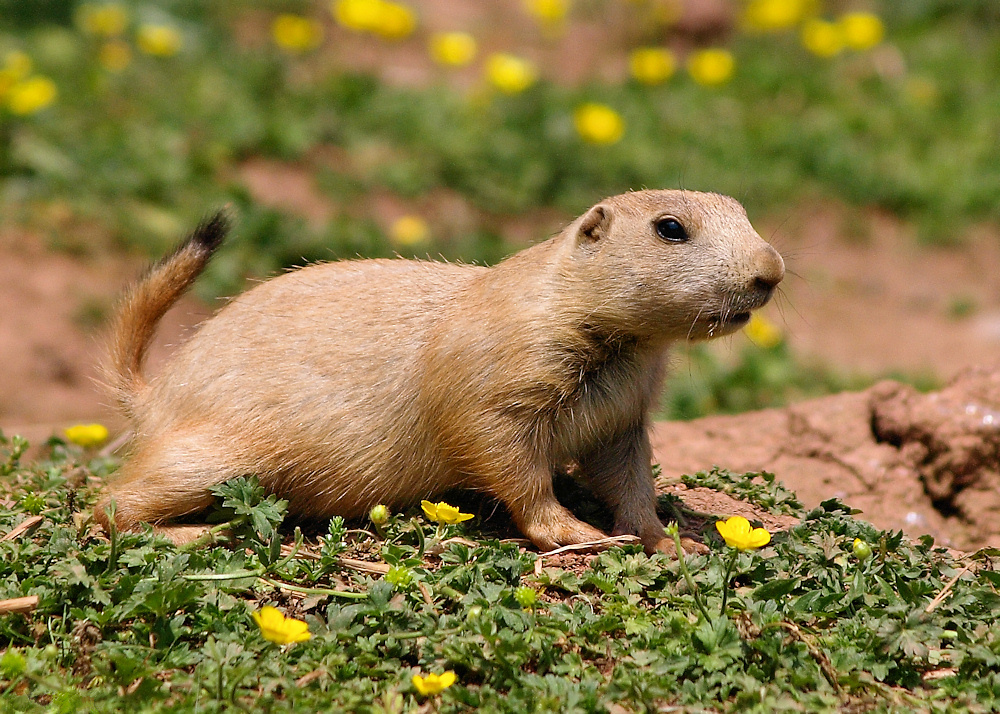 Photo of a prairie dog. The light brown rodent perches attentively amid a dry field of clover with yellow flowers.
The dry gully arroyo is a 1777 borrowing from Modern Spanish arroyo, meaning “stream”. It’s a direct descendant of Classical Latin arrugia, meaning “mineshaft.”
The dry lake playa is a 1777 borrowing from Spanish playa, meaning “beach”.
The South American plains pampas is a 1790 borrowing from American Spanish pampa, with the same meaning. The Spanish term is a borrowing from Quechua pampa, meaning “plains”.
The lonely hill butte is an 1805 borrowing from French butte, meaning “mound”. The French term can be reconstructed back to Proto-Germanic buttaz, meaning “end”.
The mountain range sierra is an 1807 borrowing from Spanish sierra, meaning “saw”, referring to the sawtooth horizontal profile of a mountain range from afar. It is a synonym of cordillera. The Spanish term is a direct descendant from Classical Latin serra, meaning “saw”.
The line of cliffs palisades is an 1827 coinage based on military palisades. It originally describes striking cliffs along the Hudson that were notable enough to be depicted on the first European map of the New World in 1541.
The deep ravine gulch is an 1832 coinage based on the obsolete word gulsh, meaning “sink in”. It was originally specific to the American West during the gold rush.
The narrow valley canyon is an 1837 borrowing from Spanish cañón, with the same meaning. The Spanish term is a coinage based on caño, meaning “tube”.
The flat-topped plateau mesa is an 1840 borrowing from Spanish mesa, meaning “table”. The Spanish term is a direct descendant of Classical Latin mēnsa, also meaning “table”.
The watery sinkhole cenote is an 1841 borrowing from Yucatan Spanish cenote, with the same meaning. The Spanish term is a borrowing from Maya tsʼonoʼot, meaning “hole with water”.
The eroded arid badlands is an 1850 calque of Canadian French Mauvaises Terres, meaning “bad lands”. The French term is itself a calque of Lakota Makȟóšiča, meaning “bad lands”.
What is a human? A miserable little pile of clades!
Wait, a pile of what? “Clade” is a scientific borrowing from Greek κλάδος (kládos), meaning “branch”. It means a common evolutionary ancestor and all of its descendants, representing a branch on the tree of life. Since cheap genetic sequencing enabled its wide adoption in the 1990s, cladistics has become the dominant way biologists classify life.
An idle conversation about octopuses and jellyfish earlier this week inspired me to learn about the concentrically nested clades humans are in. One way I like to learn more about things is summarizing the new information in a digestible way. So that’s where you, dear guinea pig reader, come in. Evolutionary biology is not my field, so I want to hear about any mistakes I’ve mad in this summary.
I find cladistics especially inspiring because it’s a recent total paradigm shift in a hard science. If I were writing this article in 1996, it would look completely different. Sure, it would probably be published in a local science fiction zine instead of a personal blog, and it would probably have taken ten times longer to research. More importantly, the methods we used to ascertain the truth would be different. So the resulting information would be different, and the inferences that we would make about life would be different. It’s wild to consider.
Let’s climb the tree of life from most to least specific. We’ll go through what each clade is named for, its distinctive features, and what’s in it that wasn’t in the next smaller clade.
- Humans are hominins. Hominins are apes named for their humanity. Hominins walk on two legs and have larger brains. Humans are the only extant (non-extinct) hominins. Extinct hominins include neanderthals, australopithecuses, and paranthropuses.
- Humans are apes. Apes are primates that are also called hominoids for their similarity to humans. Apes have long arms, no tails, and more complex brains. Apes that are not hominins, from closest to furthest, include chimpanzees, gorillas, orangutans, and gibbons.
- Humans are primates. Primates are mammals named hundreds of years ago for being the best or highest kind. Primates have color vision, more complex brains, five digits on each limb, and opposable thumbs. Primates that are not apes include simians (monkeys) and strepsirrhines (lemurs and lorises).
- Humans are euarchontoglires. Euarchontoglires are a recent grouping of mammals named for being the union of the best kind (euarchonts) and rodents (glires). Euarchontoglires that are not primates include all rodents (such as hamsters, squirrels, guinea pigs, and beavers) and lagomorphs (bunnies).
- Humans are placental. Placental mammals are named for their extended development within their mother’s uterus. Placental mammals have a corpus callosum connecting their brain hemispheres, and a separate anus and genitals rather than a cloaca. Placental mammals that are not euarchontoglires include nearly everything that we think of as mammals. Anteaters, elephants, manatees, bats, deer, giraffes, horses, dogs, cats, the whole lot.
- Humans are mammals. Mammals are vertebrates named for their milk-producing mammary glands. Mammals all have a neocortex, sweat glands, a diaphragm, a middle ear with three bones, and a four-chambered heart. Mammals that are not placental include monotremes (echidnas and platypuses) and marsupials (such as kangaroos, koalas, and opossums).
- Humans are cynodonts, therapsids, and synapsids. Cynodonts are named for their canine teeth. Therapsids and synapsids are named for the bony arches in their skull behind each eye. Cynodonts have fur and are warm-blooded. Synapsids have different types of teeth, typically canines, molars, and incisors, and stand upright on four legs. There are no extant cynodonts, therapsids, or synapsids that are not mammals.
- Humans are amniotes. Amniotes are vertebrates named for being able to reproduce far from bodies of water. Amniotes have skin made of keratin, breathe using a ribcage that expands and contracts, and have adrenal glands. Amniotes that are not synapsids include sauropsids, which include all reptiles and all birds.
- Humans are tetrapods. Tetrapods are vertebrates named for their four limbs. Tetrapods have eyelids, tear ducts, tongues, and a middle ear. Tetrapods that are not amniotes include lissamphibia, which include all amphibians.
- Humans are gnathostomes. Gnathostomes are vertebrates named for their jaws. Gnathostomes have teeth, a stomach, a spleen, and a thymus. Gnathostomes that are not tetrapods include nearly all extant fish, including cartilaginous sharks.
- Humans are vertebrates. Vertebrates are animals named for their spinal column. Vertebrates have a cranium, eyes, ears, and a nose, a multi-chambered heart, and a digestive system that includes a pancreas, liver, and intestines. Vertebrates that are not gnathostomes include jawless fish (hagfish and lampreys).
- Humans are chordates. Chordates are animals named for their notochord, a body-spanning column of cells that becomes the spinal column in vertebrates. Chordates have tails and thyroid glands. The few chordates that are not vertebrates include tunicata (sea squirts) and cephalochordates (lancelets).
- Humans are deuterostomes. Deuterostomes are animals named for their first embyronic opening becoming an anus, rather than a mouth. Deuterostomes have gill slits that open into their pharynx, a hollow nerve cord, and a segmented body. Deuterostomes that are not chordates include echinoderms (starfish, sea urchins, and sand dollars) and hemichordates (acorn worms).
- Humans are bilateria. Bilateria are animals named for their bilaterally symmetric body plan. Their symmetry gives bilateria a front head and rear tail, a ventral belly and dorsal back, and left and right sides. As they mostly move in the direction of their head, it has sense organs and a nerve center. Bilateria that are not deuterostomes include protostomes (all insects, earthworms, squids, and octopuses), named for their first embryonic opening becoming a mouth, rather than an anus.
- Humans are animals. Animals are multicellular organisms named thousands of years ago for having a soul. Animals can move and must get energy from eating other organisms using an embryonic opening called a blastula. Animals that are not bilateria include cnidarians (anemones, corals, and jellyfish) and porifera (sponges).
- Humans are opisthokonts. Opisthokonts are organisms named for the rear flagellum their cells use to move. Opisthokonts cannot produce their own food and must consume other organisms to survive. Opisthokonts that are not animals include all fungi.
- Humans are podiates. Podiates are organisms named for their cells having pseudopods for movement. Podiates that are not opisthokonts include amorphea (slime molds and amoebas).
- Humans are eukaryotes. Eukaryotes are organisms named for having a cell nucleus. Eukaryotic cells have organelles, mitochondria, chromosomes, and a cytoskeleton, and reproduce through mitosis. Eukaryotes that are not podiates include diphods (all plants and algae), which have plastids that generate energy from the environment.
- Humans are alive. Living organisms are named for being alive. Living organisms all die, encode information about themselves in DNA, and can reproduce. Life that is not eukaryotic include archaea and prokaryotes (all bacteria). Living things that are not organisms include viruses.
And that’s life.