wizard
The archetype wizard arrives at its current meaning of “occult magician” around 1600. Before that, it meant something closer to “sage”, illustrated by its components of wise + -ard when it was coined around 1440. Wise predates English and can be reconstructed back to Proto-Germanic wīsaz, meaning wise, and even beyond that to PIE weyd-, meaning “to see”.
-ard, meanwhile, hasn’t been a productive suffix for a long time, so I found it helpful to look at other words that include it: drunkard, dotard, dullard. Wiktionary aptly describes it as a “pejorative agent suffix”, so wizard probably originally meant something like contemporary “smartass”.
The more modern sense of “ace” or “skilled practicioner” dates to the 1850s, probably generalizing from aces nicknamed “wizard”. Whiz, like in “math whiz”, from 1921, is possibly derived from this sense. The phrase Pinball Wizard was made famous by The Who’s 1969 song. Influenced by the “ace” sense, Microsoft began calling guided multi-step guided workflows “wizards” in 1991, leading to “install wizard” becoming a common phrase by 2001.
really
The general intensifier really arrived at its current meaning around 1561. The word in its original meaning of “actually”, from real + -ly, is attested from the 1450s. Real is one of the many words borrowed into English from Norman French in the 1300s, in this case from reel, meaning “actual”. Reel descends straightforwardly from Latin reālis, also meaning “actual”, which derives from earlier Latin rēs, meaning “thing” or “matter”.
Really’s gradual shift from meaning “actually” to meaning “very” is surprisingly precedented! The “actually” sense of truly (Old English trēowe, meaning “true”) goes back over a thousand years, but its recent meaning shift toward “very” is not even acknowledged by the OED yet. (It is acknowledged in the other dictionaries I checked.) Even the canonical general intensifier very (Latin vērus, meaning “true”) shifts in meaning from “actually” in 1200-1500 to, uh, “very” after 1550. Literally (Latin littera, meaning “letter”) in the process of shifting from “actually” to “very” is in very good company.
You are made of stars
Literally. A few minutes after the Big Bang, the universe was cool enough for the first elements to spontaneously form, deuterium and helium. That was all that existed for hundreds of millions of years, until the first stars formed, creating
The thing is, even millions of degrees at the pressure of a stellar core is insufficient to fuse that helium into anything heavier. Those reactions need to happen in red giant or larger stars, which probably required the first stars to first die out after burning for billions of years, and gradually created carbon, oxygen, silicon, and so on. Just imagine how weird planetary systems must have been during those first few billion years: every planet a gas giant or small ball of gas.
But that isn’t even the most amazing part. Even in the center of the largest supergiant stars, there isn’t enough temperature and pressure to fuse any element heavier than iron. With an atomic number of 26, that includes all of the cobalt, nickel, copper, and zinc in the universe. Those are all created in the fractions of a second where supernovas collapse in on themselves. They are then blasted around the universe with the force of a, uh, supernova.
You, of course, would not be able to function without all of the zinc (32 ppm), copper (1 ppm), selenium (0.19 ppm), and iodine (0.16 ppm) inside of you. You probably could not have existed just if the universe were only 5 billion years old. In a very real way, you are made of exploded stars.
neon
The element neon was discovered and named in 1898, when the periodic table looked like this. You may notice the lighter elements are nearly all accounted for, except for the noble gases, which remained elusive due to not interacting with anything. That year, Sir William Ramsay and Morris Travers used a novel apparatus to isolate and remove all gases individually from a sample of air, identifying three previously unkown trace (neon is 18 ppm of air) nonreactive elements. Neon was named after Greek νέος (néos), meaning “new”. The other two elements were named krypton (hidden) and xenon (foreign).
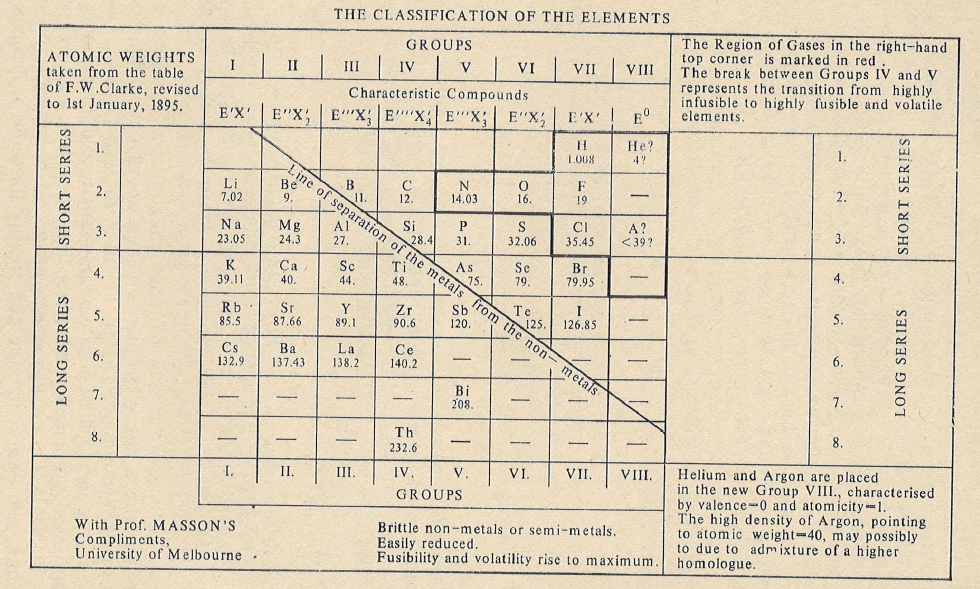
A naturally-occurring element, the vast majority of all neon in existence originates from oxygen-helium fusion in main sequence stars. While experimenting with his discovery, Ramsay noticed that neon gave off a brilliant, unforgettable red glow when electric current was passed through it. Commercial exploitation of this valuable property was initially discouraged by neon’s scarcity and cost. Once neon started being extracted from air in useful amounts in 1902, the first neon lights were created in 1923 (prototyped 1910) by replacing the nitrogen in Moore Tubes with neon. People would stop and stare at the unmissable lights even in daylight, describing them as “liquid fire”.
The neon sign’s heyday was the 1930s through 1950s, with a retro revival in the 1980s. They could be used as a visible shorthand for the growth of the modern advertising industry. Today, most light fixtures we call “neon signs” are actually LEDs. The adjective also stuck for the “neon colors” we associate with those signs (actually produced by phosphor coatings that fluoresce under UV light, which neon lights emit), commonly used to refer to highlighters. Sixteen Crayola crayon colors were rebranded as neon colors in 1993.
paywall
The virtual palisade paywall is first used to describe a membership-restricted sports website in 2004. The Wall Street Journal’s site had been paywalled since 1996, but this was such a rare practice that we didn’t need a word for it until much later. The Great Paywalling did not in fact begin until the early 2010s, when it became clear the previously dominant ad-supported model could not sustainably fund good journalism. For example, the NYT’s paywall went up in March 2011.
Paywall is obviously a compound of the common words pay- and -wall, but the choice of -wall in particular is influenced by the parallel firewall. Referring to computer security systems since 1971 and popularized in the 1983 hacker movie WarGames (“the only winning move is not to play”), a firewall referred to any system that separated unauthorized users from other critical systems. It settled on its current more specific meaning of a passive deterrence that blocks automated intrusions in the 1990s.
Firewall’s computer security meaning arose from a metaphor for its physical meaning, a fire-resistant barrier preventing the spread of fires by separating burnable things from each other. Uncontained, wildly spreading fires used to be a major problem for cities; firewalls, first attested in 1851, were one of many tools developed and deployed to combat this. The more general meaning of a protective barrier of any sort is from 1907.