photoshop
The touch-up method photoshop, first used as a generic verb in 1992, is named after Adobe’s 1987 image editing software Photoshop. The software, in turn, is likely named for the offset lithography department photoshop, where people would touch up photographs before they went to print.
The word photograph was coined in 1839 by English chemist Sir John Herschel, combining Greek φῶς (phos), meaning “light,” and γραφή (graphê), meaning “drawing”. However, most early photographs were instead called daguerreotypes, after Louis Daguerre’s development of the first practical photography process. Daguerreotypes were ascendant from their invention in 1839 until the development of the less restrictive wet colloidon process in 1851, rarely appearing after 1860.
φῶς is actually a regional form of Ancient Greek φάος (phắos), which can be reconstructed back to PIE bʰéh₂os, also meaning “light”, by comparing it to its relatives like Sanskrit भास् (bhās), meaning “light”.
Photoshop was a popular enough topic that the clipping shopped can be found since the early 2000s. You can compare the trend to its genericized contemporary autotune, created in 1997 and popularized in Cher’s 1998 hit “Believe”.
juggernaut
The unstoppable juggernaut is first attested in English in a 1638 article, a transliteration of the name of the regional Hindu deity ଜଗନ୍ନାଥ (Jagannātha). For the next 200 years, it’s only seen as a proper noun referring to this specific deity, mostly centered around the annual Ratha Yatra festival in Puri, a city on the east coast of India. The festival includes a procession of massive (40’/15m) horse-drawn chariots, with the largest and grandest devoted to Jagannath.
Held annually since 1460, this festival left such an impression on English observers that the name Jagannath itself came to stand for the unstoppable momentum of its lead chariot. Beginning in 1854, “Jaggernaut” became a metaphor for inexorability, its ending now influenced by the English suffix -naut. It became a fully lowercase common noun used to describe any gigantic heavy vehicle by the mid-1900s, in addition to the unstoppable metaphorical use.
Its most familiar use today originates with the Marvel villain Juggernaut, introduced in a 1965 X-Men comic book and perhaps most well known for the “Nothing Can Stop the Juggernaut!” storyline in 1982 Spider-Man comics.
Jagannath’s name originates from Sanskrit जगन्नाथ (jagannātha), meaning “lord of the universe”, from जगन् (jágan) “world” + नाथ (nāthá) “lord”.
laser
The device laser was named by American physicist Gordon Gould in a 1957 lab notebook describing a theoretical invention. The notebook includes the heading “Some rough calculations on the feasibility of a LASER: Light Amplification by Stimulated Emission of Radiation”, patterned after the existing acronym MASER (microwave amplification by stimulated emission of radiation). American engineer Theodore Maiman built the first working laser in 1960. Lasers were commercially viable just 14 years later, with the introduction of barcode scanners in 1974, laserdisc and compact disc (CD) players in 1978 and 1982, and laser printers in 1984.
In the 1960s, lasers were typically called “optical MASERs”, as they operated under the same principle, but emitted visible light rather than microwaves. Laser is notable as one of the first acronyms to lose its acronym status and become a lowercase common noun, along with scuba (1952) and radar (1940). A good rule of thumb is any proposed acronym word origin from before 1940 is made up after the fact. For example, acronymic folk etymologies like “for unlawful carnal knowledge” are common for obscene words.
I find it fascinating to think of lasers in the context of science fiction weapon naming. In the 1920s trend that focused on effects, they’d be called something like “heat rays”. Conversely, under the 1960s paradigm of naming things after particles, they’d be called something like “photon cannons”. I think the current fashion is to notice that technology tends to be named for specific implementation details, as with laser, but that is of course unlikely to remain true over the next hundred years.
maize
The grain maize is first found in English as a loanword from Spanish maíz in 1541. Maíz is first attested in Spanish by Christopher Columbus in 1500 as a loanword from Taíno mahis, meaning “maize”. Maize was first domesticated in what is now southern Mexico about 9,000 years ago (compare to wheat 12,000 years ago, rice 9,000 years ago) from wild teosinte.
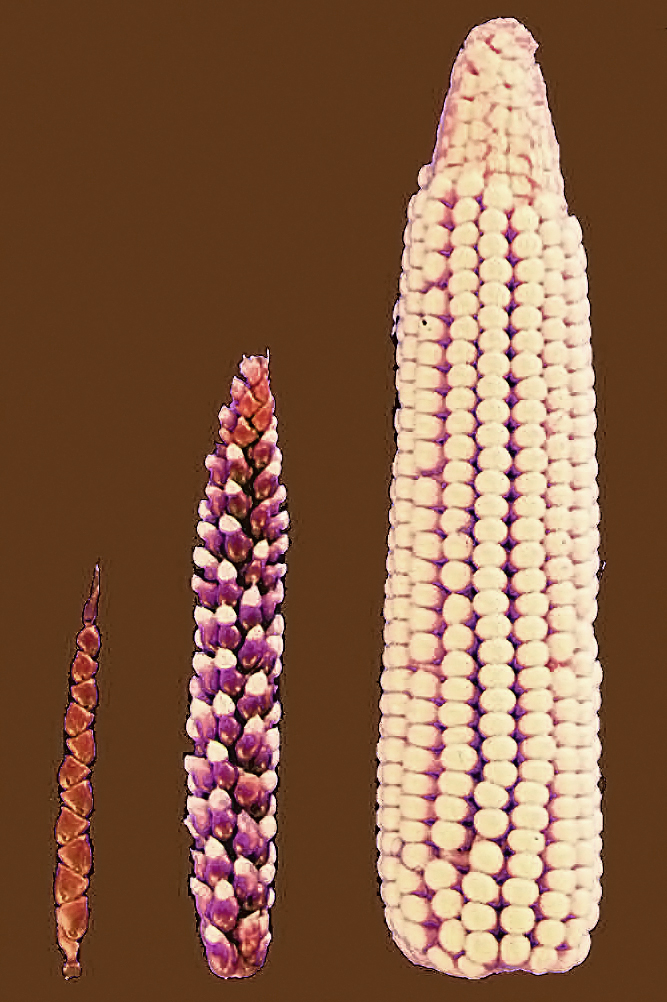 Ears of wild teosinte, a teosinte-maize hybrid, and maize, from left to right. The teosinte is reddish-brown and has about 24 total kernels. The maize is two and a half times longer and about six times wider than the teosinte.
The magnitude of this achievement is made apparent by a side-by-side comparison of wild teosinte, which produces a single ear of corn per plant, with maize. Just as striking is the fact that corn, the generic word for “grain” in most world Englishes, only means “maize” in US English and Canadian English. (Corn and grain are an Old English-Norman French doublet that both descend from the same PIE word, ǵr̥h₂nóm.)
How did that meaning shift happen? Even before the first British colony in North America, we can find people referring to maize as “Indian corn”, the grain that those savages eat. That was its common name for centuries. By 1800, it was common to drop the “Indian” qualifier and just call maize corn in the US.
karaoke
The activity karaoke, first attested in 1977, is a loanword from Japanese カラオケ (karaoke), meaning “karaoke”. It’s clear that it’s become a naturalized English word since then when you look at its pronunciation: “carry-OH-key” is almost unrecognizable next to “kah-rah-oh-KAY”.
カラオケ is a portmanteau of 空 (kara), meaning “empty”, and オーケストラ (ōkesutora), a loanword from English meaning “orchestra”. The Japanese neologism also dates to 1977, even though prototype karaoke machines were built as early as 1971. The innovation that distinguishes karaoke from the sing-along songs that inspired it is the removal of the lead vocal track. The opportunity opened up with the extra storage available in jukeboxes powered by 8-track tapes rather than records. Before everyone settled on calling it “karaoke”, some of the prototypes were called “8 Juke”, “Sing-Along System”, and “Sparko Box”.
Orchestra, first attested in English in 1606, is a loanword from Latin orchēstra, meaning “orchestra”. That in turn is a loanword from Greek ὀρχήστρα (orkhḗstra), derived from the root ὀρχέομαι (orkhéomai), meaning “to dance”.