What does a newborn career look like?
As I stare down the barrel of an LLM-induced career change, I’ve been thinking about the lifecycles of careers themselves. When I was a kid, sysadmin was not a valid career option, let alone voice actor or 3D modeler. Meanwhile, technology disrupted how travel agents, accountants, and stock photographers work, but they persist nevertheless. Established careers we take for granted today, like scuba instructor, rocket scientist, and brain surgeon, didn’t exist 100 years ago. Where do new careers come from, and what does a newborn career look like?
I’m reminded of some advice for new grads I heard from a youtuber: look for things that weren’t possible ten years ago, things where established businesses will make it hard to get started ten years from now. That’s what a newborn career looks like. The way “youtuber” might have looked ten years ago. Doing things that make money, but aren’t seen as respectable yet.
How can you look for things that weren’t possible ten years ago? Technology may be the obvious answer, but it’s not the only answer. The way I try to go about it here is by noticing isolated, interesting trends and trying to draw connections between them.
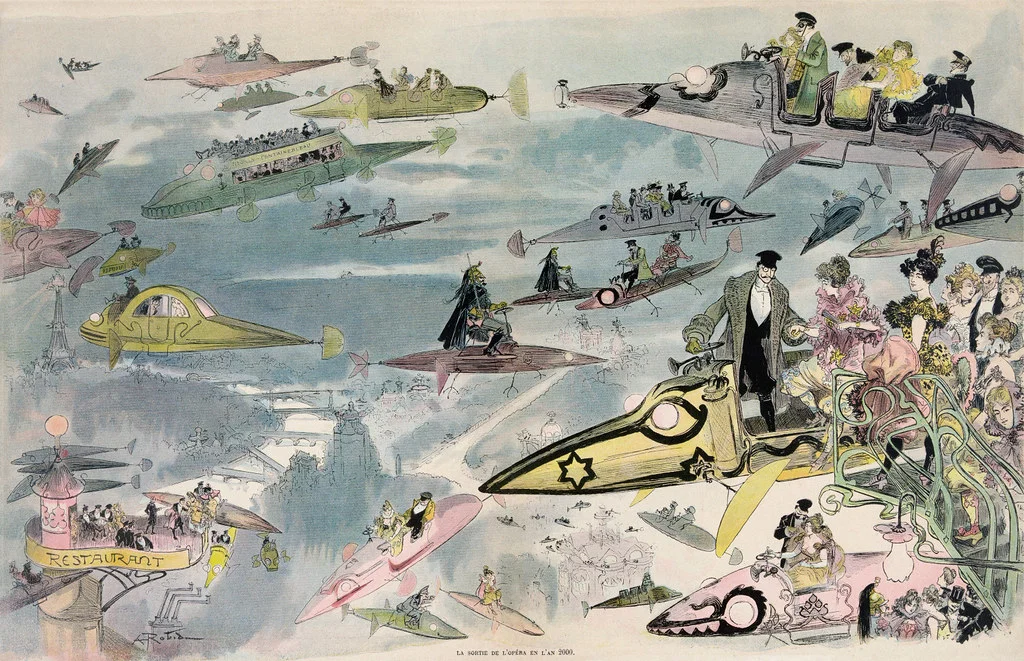 1902 print depicting many bizarre aircraft and their pilots in the skies above Paris. The title, “Le Sortie de l’opéra en l’an 2000”, meaning “Leaving the opera in the year 2000”, is displayed in the bottom center. The Eiffel Tower is faintly visible in the background in the left.
One need worth lots of potential revenue that’s currently unmet is immersive team-building experiences for corporations. In the last 15 years, we’ve seen the rise of people paying or traveling great distances to have novel experiences. Some examples include immersive theater, escape rooms, and large-scale larping. Many people are willing to go to great lengths to have novel experiences that are otherwise impossible.
Corporate team-building exercises have a long history. Trust falls and ropes courses have been corporate retreat cliches for longer than I’ve been alive. Axe throwing recently emerged as a more hipstery thing you can do as a team. I’m going to make a brave argument: team-building experiences don’t have to be bad. In fact, I will argue that they are better if they are good.
You could grow a business that fulfills this need by starting with a more appealing pitch: create a soulful experience that people would enjoy doing with their friends on a weeknight. Something interactive and immersive like an escape room, but incorporating some elements from immersive theater and larping that make those so compelling. If you succeed at this admittedly difficult goal, you can follow Slack’s customer acquisition model. The consumer product is the high-quality loss leader that generates word of mouth for the enterprise product, which is ten times more expensive for unspecified enterprise reasons. Today, corporate team-building budget is often devolved to individual teams in a show of autonomy. There are thousands of relatively naive purchasers inside each of those companies trying to spend money they’ll otherwise lose. It’s an ideal match for this type of guerrilla marketing.
If having to interface with corpos sounds too distasteful, there’s another business opportunity that still involves creating soulful experiences, but with a different business model. When I reflect on all the conferences, retreats, and classes I attended to learn something, the most successful ones featured experiential learning. They set up low-pressure situations where you can practice the thing you’re trying to learn under simplified, safe conditions. Then they give you free rein, letting you fail and try again until you figure out what works and why.
This is not far removed from unschooling models of child education like Montessori. Unschools are generally seen as effective, selective, and expensive. But what if you could get many of its benefits for a fraction of the time, money, and exclusivity? In the US, summer camp is an institution of upper-middle-class culture. You could create a week-long summer camp that specializes in experiential learning in a specific high-demand interest, like becoming an influencer or astronaut.
It might not even have to be a specific interest. Consider the recent success of adventure playgrounds and job-themed children’s amusement parks. Maybe a week where kids just get to decide what to do for themselves would be enough enticement.
One big challenge with this approach is assessment. It’s one thing to claim that experiential learning has been personally effective for me, but quite another to prove it shows up on standardized tests. You’d trade out the bugbear of working closely with corporations and corporate culture with the specter of working closely with schools and educator culture.
An understated benefit of life under capitalism is the comfort that I’m not the only one who can see these emerging trends. Other people chasing their fortunes have noticed them too. And I trust that if they’re actually viable, someone will figure out how to make them a reality, one way or another. One of those people’s stories and its associated fortune could be yours.