Effective pre-journaling
I went on a meditation retreat with Jhourney last year that I can fairly describe as life-changing. They take a secular, evidence-based approach to meditation that some practitioners will find distasteful and others with see as a perfect fit. In particular, they use a lot of tools for thought that I recognize from consulting. Although one in particular I found very useful doesn’t seem to originate from either consulting or psychology. I wonder if it’s something the team came up with themselves.
They call it the PLAN framework for journaling. I don’t have the text handy, so I’m not going to get it exactly right. But maybe my unintentional changes will make it more memetically transmissible.
If you have some time before doing something important, write some notes to organize your thoughts first. Use the prompts:
Purpose. What is my goal? What am I trying to accomplish and why? Are there different, easier ways to get what I actually want?
Learned. What do I know that’s related to the goal? What happened the last time I tried to do something like this? What happened when someone else tried something like this?
Action. What specific actions to I plan to take to achieve my goal? Write out the details and see if anything stands out.
Needs. What is some thing or knowledge that, if I had it, would make doing these things dramatically easier? Can I figure out how to get that?
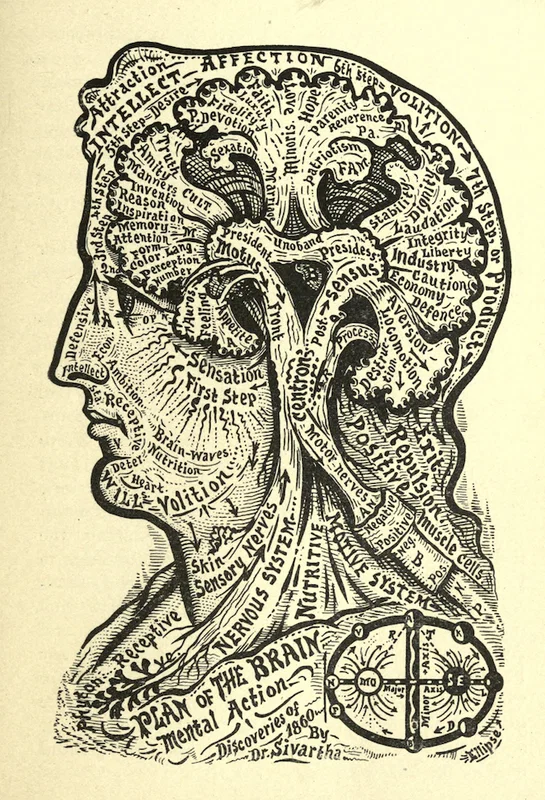 Scan of an 1860 diagram of the parts of the brain, overlaid on a man in profile. Some parts have labels like Manners, Patriotism, Industry, and Aversion.
Moving from abstract to concrete and back helps with learning, so here’s an example:
Purpose. I want to figure out what to write for tomorrow’s post. There’s a lot of ideas in my list. I want to pick one so that I can get some thinking and writing in ahead of time.
Learned. History posts seem very compelling to me while I’m writing daily. Memoir posts seem to get a lot of traction, but the required vulnerability leaves me drained. I enjoy review posts, but feel a lot of pressure to get the details right. List posts are quick and easy on an off day. I should set an intention ahead of time if I want to try a kind of post that scares me.
Action. Go through the ideas list from most to least recent. My best ideas so far seem to happen when I can write a single post that hits two or more of them. It’s a fun puzzle to solve that sometimes hits me with related inspiration. Matching a content idea to a form restriction works well, but finding a throughline between two content ideas is even better.
Needs. What’s my schedule today and tomorrow? Do I have any plans that align with a particular topic or theme? Is there someone I can chat with who’d really inspire or inform my work on a subject? Who do I want to spend time chatting with that I haven’t had the opportunity to yet?
In my experience, writing these out when I’m faced with a thorny problem has been well worth the time spent. Each of the four prompts has led me to important realizations. In particular, the “dramatically easier” framing in Needs often helps me notice that I should do or ask something else first. That someting else might lead me to never actually take the actions, but get what I want anyway. Unfortunately, skipping directly to just that prompt without going through the other ones doesn’t seem to work as well.
One hint that makes me suspect the Jhourney team created this themselves is, the mnemonic absolutely does not work for me. I can recall it now through repetition. But the first few times, I had to look up the words every time despite knowing their first letters. Needs, really? But I can’t deny the effectiveness of the questions. If you can come up with a better mnemonic, I’d love to hear it.