wifi
The basic human need wifi isn’t an abbreviation for anything. A consortium of telecom companies that included 3Com, Lucent, and Nokia registered the commercial trademark Wi-Fi in 1999, calling themselves the Wireless Ethernet Compatibility Alliance. The WECA had tasked branding firm Interbrand with developing a name for their nascent technology. Interbrand came up with Wi-Fi, selected in part for its resemblance to hi-fi. While some WECA (who renamed themselves Wi-Fi Alliance in 2003) bulletins claimed it stood for “wireless fidelity”, they were in the minority. The generic term for wireless internet stations, now disused in favor of wifi, was “fixed wireless”. In technical discussions, people do sometimes use the name of the original spec instead, 802.11b.
The positive quality hi-fi is first attested in 1935 as an abbreviation for high-fidelity. High-fidelity described a new generation of audio devices that minimized playback artifacts like surface noise and distortion. Existing devices were given the retronym low-fidelity. Hi-fi sound systems became commercially available in the mid-1950s, rapidly replacing lo-fi systems. In contemporary Indian English, the meaning of hi-fi has since generalized to “modern” or “fashionable”.
Also in the mid-1950s, people started calling the sound system itself a hi-fi in metonymy. Hi-fi used as a noun sounds unusual today because a different metonym became the common term for a home sound system in the mid-1960s. Stereo is a 1954 clipping of the 1927 term stereophonic, describing a sound system that simulates three-dimensional playback by playing different audio channels from different speakers. The scientific prefix stereo-, meaning “three-dimensional”, is a borrowing from Ancient Greek στερεο (stereo), meaning “solid”, that became productive in the sciences (e.g. stereomer, stereofluoroscope) in the 1860s.
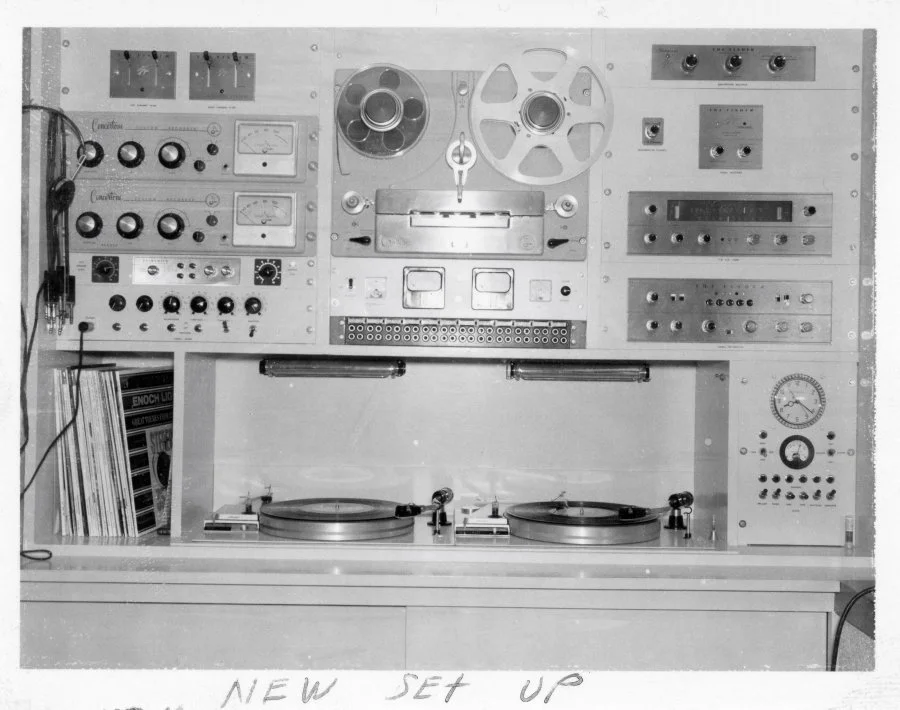 Black-and-white 1950s photo of an enthusiast hi-fi setup. Many analog gauges and black or metallic knobs fill the side panels. A reel-to-reel is prominent in the top center. The bottom section features two turntables and a record collection. Notably, nothing resembling a speaker is visible.
Meanwhile, the retronym low-fi took on a life of its own after entering common usage in 1954. In the 1960s, low-fi music referred to what we think of as garage bands today, indie music featuring minimal production values. New Jersey DJ William Berger’s 1986-1987 radio show “Low-Fi” was a focal point of the 1980s transformation of the DIY low-fi aesthetic into an intentional marker of pride in the era of punk and grunge. 1993 and 1994 New York Times articles about the aesthetic influenced a spelling change to lo-fi.
Another generation later, 2015 saw Youtube livestreaming radio stations labeling themselves “lo-fi hip-hop” or “chillhop” rise in popularity. The genre had grown out of 2000s underground hip-hop scenes that often made use of the Roland SP-404 sampler, a 2005 device with a button labeled “LO-FI”. The genre’s exemplar became Lofi Girl, a French music label originally founded in 2017 as ChilledCow, renamed in 2021 after its iconic animation. Today, lofi typically refers to chillhop music and its cozy beats.
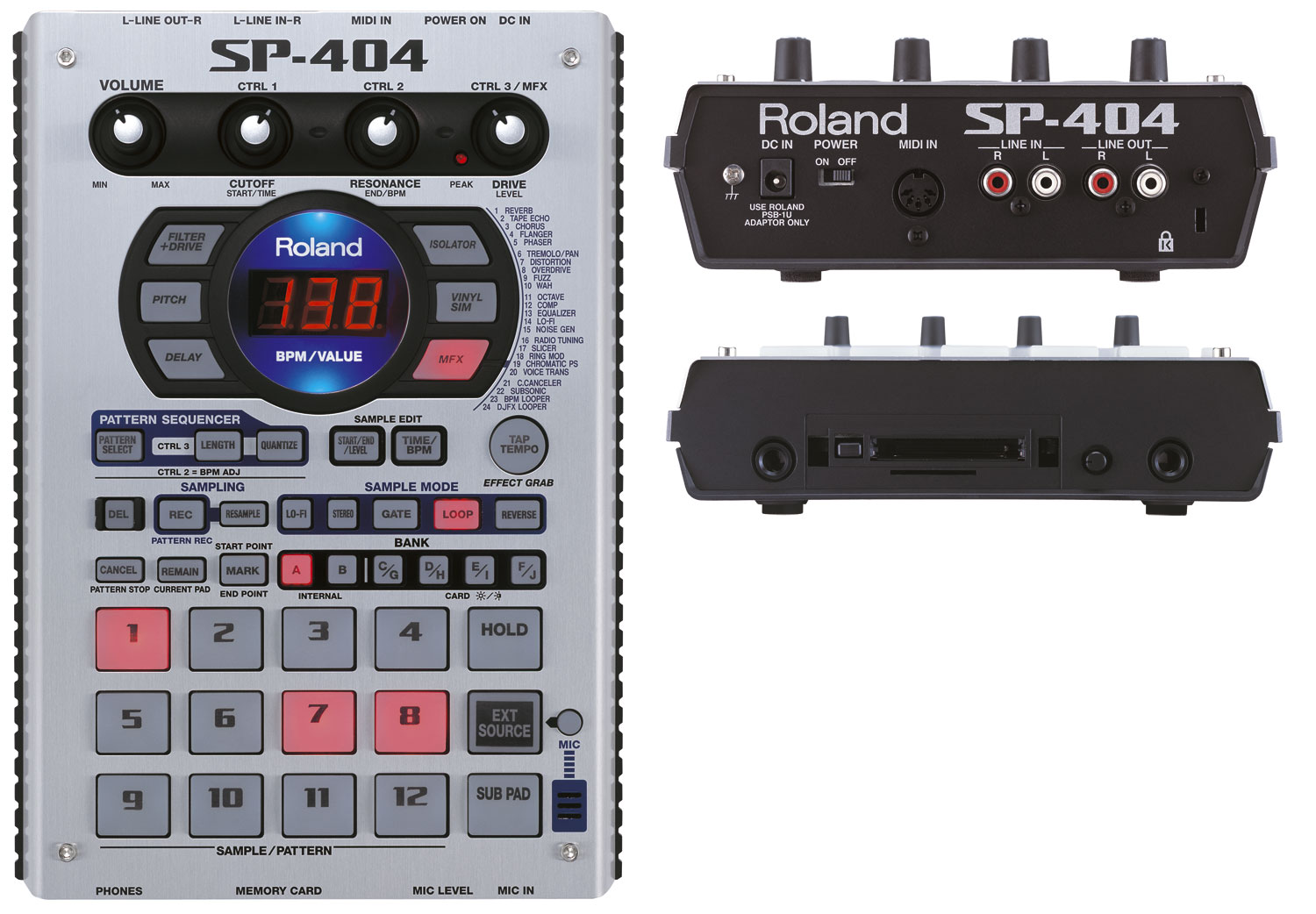 2016 photo of a Roland SP-404 sampler. It is a book-sized brushed aluminum device studded with rubber buttons reminiscent of a 1990s TV remote control. Some buttons are backlit in soft red, indicating they are toggled on. The leftmost button in the center “sample mode” group is labeled “LO-FI”.
The adjective wireless first appears in 1825 with its surface definition, “not requiring wires”. In 1889, wireless starts referring to the emerging discipline of radio, a clipping of “wireless telegraphy”. Radio becomes the standard term for the medium after its 1907 coinage, but wireless stuck around as an uncommon synonym for “radio receiver” through the 1900s. Around 2001, wireless was also used as a clipping of “wireless internet”, before wifi became the standard term.
The faithful quality fidelity is an early 1500s borrowing from Old French fidélité, with the same meaning. The French word is a direct descendant of Classical Latin fidēlitās, also with the same meaning. Its roots are the familiar fidēlis, meaning “trustworthy” or “faithful”; and the suffix -tās, roughly equivalent to “-ness”. Fidēlis was derived from Classical Latin fidēs, meaning “faith” or “trust”, which can in turn be reconstructed all the way back to PIE bʰeydʰ-, meaning “trust”. One English descendant of that same PIE root but through Germanic is bide.
We can identify specific kinds of faithfulness that fidelity has focused on by looking through its derived terms. Faithfulness to one’s liege can be seen in fealty, an earlier (pre-1300) English borrowing from the Norman French equivalent, fëauté. Faithfulness to one’s spouse is the sense found in infidelity. The fidelity of a model or simulation describes its faithfulness to reality. The fidelity of a translation or copy quantifies its faithfulness to the source material, as in hi-fi. Faithfulness to one’s religion is the sense used in infidel, a 1480s borrowing from French that meant “non-Christian” or “atheist”. The prevalence of infidel as an English translation of Arabic كافر (kāfir), meaning “unbeliever”, from the root ك-ف-ر (K-P-R) meaning “conceal”, is modern.