mesmerizing
The enthralling quality mesmerizing is first attested in 1829, as well as its base form mesmerize. The figurative usage of mesmerizing as an adjective for something spellbinding or transfixing begins appearing in 1846.
Today, we think of the verb mesmerizing as a synonym of hypnotizing. However, hypnosis was a later development. It was established in 1841 as a variation of mesmerism based on a different theory. Hypnosis was coined in French by mesmerist Étienne Félix d’Henin de Cuvillers in 1820 after Ancient Greek ὕπνος (húpnos), meaning “sleep”. It was first borrowed into English in 1841.
Mesmerism is based on the theory of “animal magnetism”, Lebensmagnetismus in the original German. Animal magnetism describes an invisible natural force common to all living things that can be manipulated with science. German doctor Franz Mesmer first wrote about the theory in a 1779 medical journal. It was not named after him until after his death in 1815.
For the first forty years, practitioners called themselves magnetizers. So what we now call hypnotists were typically called magnetizers from 1779 to 1820, mesmerists from 1820 to 1841, and hypnotists afterwards.
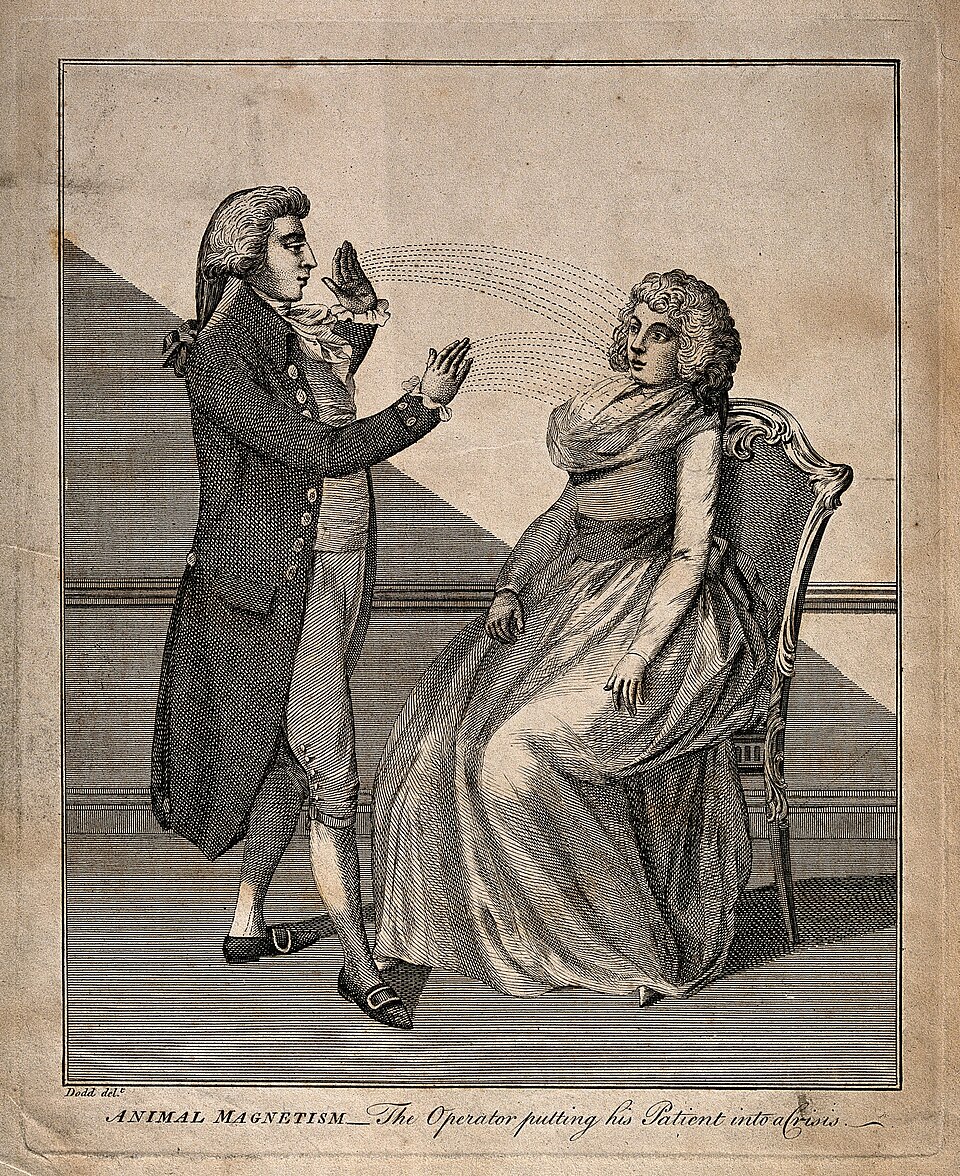 1802 engraving of a man mesmerizing a woman with animal magnetism. The man is wearing a powdered wig and a coat. He stands on the left and uses his arms to manipulate the life force. The woman is sitting in a fancy chair and wearing a long dress.
It’s worth noting that modern psychology was established in 1879. Before that, increased population density drove a need to isolate “insane” people in asylums for the good of society by the 1600s. Lunatics were typically treated as poor incurable wretches who needed to be confined, until the first more humane sanitarium was established in 1792. The English Lunacy Act of 1845 was the first legally mandate that mentally ill people be considered patients rather than prisoners, and treated appropriately.
Against this backdrop, the benefit of hypnosis as a possible treatment for mental illness where none existed makes more sense. Even if the theory didn’t pan out, the technique produced real benefits. You can see how Mesmer came up with the idea based on empirical results, absent any evidence to the contrary.
The German surname Mesmer originated as a variant of Messner or Mesner. Mesner can be traced back to Latin mānsiō (also the source of English mansion), meaning “dwelling”. It was an occupational surname for church officials in Austria and Bavaria, akin to English sexton. “Dwelling” here was presumably a metonym for church like in the phrase “house of God”.
Much MMORPG-specific slang originates from EverQuest, the 1999 game that established and codified the genre. In EverQuest, a key tool to manage incoming damage is the enchanter spell mesmerize. Likely inspired by the D&D spell fascinate, mesmerize prevents its target from acting until attacked. The specific spell mesmerize, and its inflicted condition mesmerized, came to represent the entire category of crowd control effects.
In the 2000s, it was common to refer to any “soft” crowd control that breaks when the target is hit with the clipping mez. (“Hard” crowd control is typically called stun.) A character that could mez was called a mezzer. The 2005 game Guild Wars played off this by calling its own enchanter class mesmer.
Twenty years later, the more generic term CC is more commonly used. “Mez” still sees occasional use, even in science fiction settings, or when the actual effect is more like sleep or freeze.