prairie
The grassland prairie is a 1761 borrowing from Modern French prairie, meaning “meadow”. You can trace the word backwards through time, maintaining its meaning, through Old French praerie, Vulgar Latin prataria, and Classical Latin prātum. It refers to a specific kind of meadow often found in French Canada and Louisiana. Prairie dog is from 1804, the one survivor from a family of animal names that once included prairie lark, prairie mole, prairie fly, and prairie snake.
The majority of English geographical terms are as old as the language. But a significant plurality refer to features not found in the British Isles, but in the Americas. Those showcase a diversity of origin concentrated around a short time period that I enjoy.
The creek kills is a 1669 borrowing from Middle Dutch kill, with the same meaning. The Dutch term can be reconstructed back to Proto-Germanic kiljǭ, meaning “fissure”.
The cliff face bluff is a 1687 coinage based on the obsolete nautical term bluff, meaning “having a broad, flattened front”. It was originally used to describe a cliff formation found in the American Colonies.
The grassy plain savanna is a 1697 borrowing from Spanish sabana, with the same meaning. The Spanish term is a borrowing from Taíno zavana.
The mountain chain cordillera is a 1704 borrowing from Spanish cordilla, a diminutive of cuerda, meaning “rope”. It is a synonym of sierra. The Spanish term is a direct descendant of Classical Latin chorda, meaning “intestine” or “cord”, itself a borrowing from Ancient Greek χορδή (khordḗ), meaning “guts”.
The descriptive wetland is a 1743 compound originally used to describe a type of land found in the American Colonies.
The rough section of a river rapids is a 1744 coinage based on rapid. It originally described sections of rivers found in New York.
The small island cay (or sometimes key) is a 1761 borrowing from American Spanish cayo, with the same meaning. The Spanish term is a borrowing from Taíno cayo, meaning “small island”.
The marshy waterway bayou is a 1766 borrowing from Louisiana French bayou, with the same meaning. The French term is a borrowing from Choctaw bayuk, meaning “creek”.
The river embankment levee is a 1770 borrowing from Modern French levée, with the same meaning. The French term is a coinage based on lever, meaning “to raise”, directly descended from Classical Latin levāre, also meaning “to raise”.
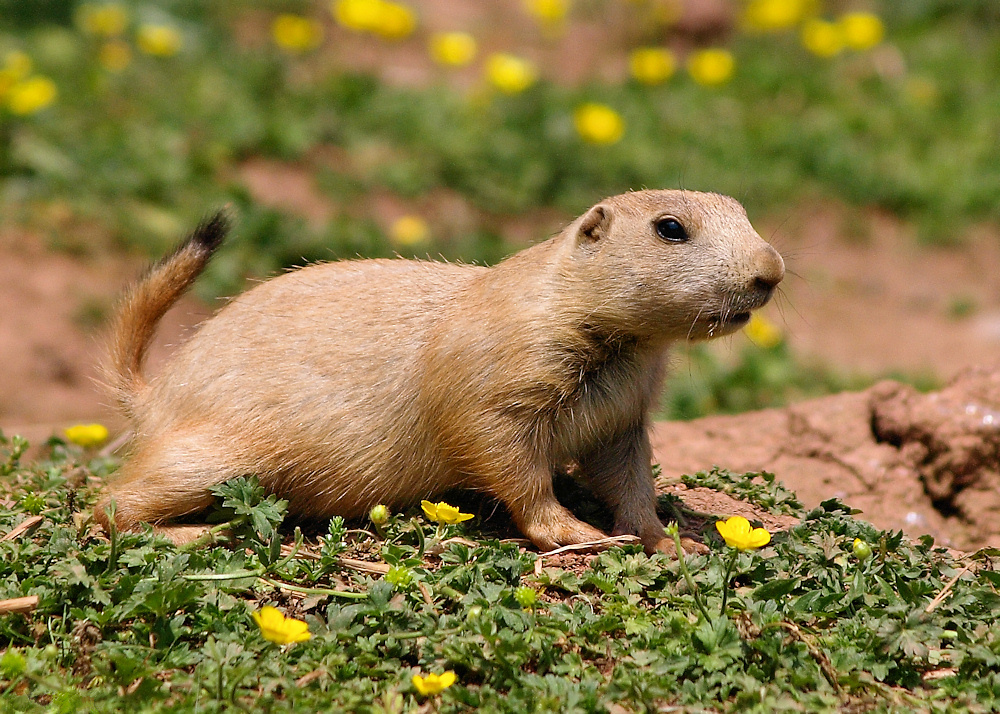 Photo of a prairie dog. The light brown rodent perches attentively amid a dry field of clover with yellow flowers.
The dry gully arroyo is a 1777 borrowing from Modern Spanish arroyo, meaning “stream”. It’s a direct descendant of Classical Latin arrugia, meaning “mineshaft.”
The dry lake playa is a 1777 borrowing from Spanish playa, meaning “beach”.
The South American plains pampas is a 1790 borrowing from American Spanish pampa, with the same meaning. The Spanish term is a borrowing from Quechua pampa, meaning “plains”.
The lonely hill butte is an 1805 borrowing from French butte, meaning “mound”. The French term can be reconstructed back to Proto-Germanic buttaz, meaning “end”.
The mountain range sierra is an 1807 borrowing from Spanish sierra, meaning “saw”, referring to the sawtooth horizontal profile of a mountain range from afar. It is a synonym of cordillera. The Spanish term is a direct descendant from Classical Latin serra, meaning “saw”.
The line of cliffs palisades is an 1827 coinage based on military palisades. It originally describes striking cliffs along the Hudson that were notable enough to be depicted on the first European map of the New World in 1541.
The deep ravine gulch is an 1832 coinage based on the obsolete word gulsh, meaning “sink in”. It was originally specific to the American West during the gold rush.
The narrow valley canyon is an 1837 borrowing from Spanish cañón, with the same meaning. The Spanish term is a coinage based on caño, meaning “tube”.
The flat-topped plateau mesa is an 1840 borrowing from Spanish mesa, meaning “table”. The Spanish term is a direct descendant of Classical Latin mēnsa, also meaning “table”.
The watery sinkhole cenote is an 1841 borrowing from Yucatan Spanish cenote, with the same meaning. The Spanish term is a borrowing from Maya tsʼonoʼot, meaning “hole with water”.
The eroded arid badlands is an 1850 calque of Canadian French Mauvaises Terres, meaning “bad lands”. The French term is itself a calque of Lakota Makȟóšiča, meaning “bad lands”.