blog
The word for the thing you’re reading right now, blog, is first found in 1999 as a clipping of weblog. Some 1999 usages render it as ‘blog to mark the contraction. In spite of the 2001 dot-com crash, the term spread as rapidly as the phenomenon. In 2004, blog was Merriam-Webster’s second ever word of the year. The year before, rival American Dialect Society had highlighted blog as the word “most likely to succeed”.
A person who writes blogs has also been called a blogger since 1999. Blogger.com provided free blog hosting from its 1999 founding through its 2003 acquisition by Google. The sociological concept blogosphere was coined to describe this burgeoning “intellectual cyberspace” in 2002. By analogy, vlog, short for “video log”, first appears in 2002. Vlogs didn’t take off until YouTube provided free video streaming from its 2005 founding through its 2006 acquisition by Google.
Weblog was first used as a word in 1998. Web here is short for World Wide Web, named by Tim Berners-Lee during its 1991 invention. In the 1980s, the virtual world was often called the ‘net (short for Internet (short for inter-network)). When describing cyberspace, 80s and 90s science fiction invented fictional terms suggestive of nets, like matrix, web, and grid. Berners-Lee’s chosen web carried on this tradition. [1]
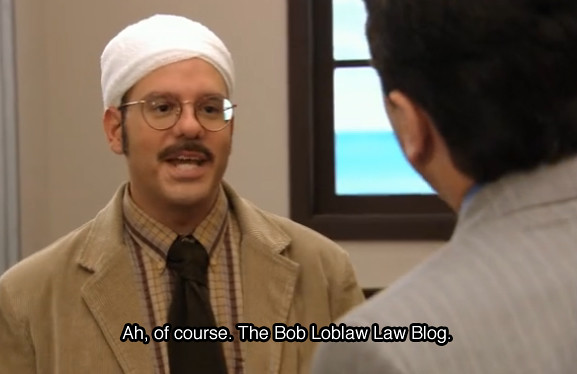 Screencap from “Making a Stand”, a 2005 episode of Arrested Development. A suited, bandanged Tobias, speaking to his lawyer Bob Loblaw and the camera, says the captioned line “Ah, of course. The Bob Loblaw Law Blog.”
An alternate form of weave, web has been the term for the object a spider weaves since before English existed. In the 1880s, we first see webbing metaphorically referring to a woven net. The food web describing species interdependence is from the 1930s. The 1994 coinage webcam generalized from “camera you can view on the web” to any camera connected to a personal computer. This is like the generalization of the 2004 coinage podcast, except that while we still use the web, we do not still use iPods.
Meanwhile, we’re not actually sure where log comes from. Log and its sibling-or-twin clog both start appearing in the late 1300s to describe felled trees. One wild guess is that clog is an onomatopoeia for the sound that a tree makes when you fell it, with log a derived clipping or regionalism. Clog eventually lost its original meaning of “log” to its relative, but not before generalizing in the 1400s to also mean either “wooden shoe” or “log attached to a prisoner to impede escape”, like today’s metaphorical ball-and-chain. The “impedance” meaning generalized to anything that slowed something down in the 1500s, then specifically gunk that impedes the passage of something in the 1740s.
Unlike its relative, log kept its original meaning of “log” to this day. It also started referring to a piece of wood for measuring a ship’s speed in the 1570s. To gauge your speed on the open ocean without any landmarks, you would throw the log overboard, wait a short time, estimate how far away it was, and reel it back in. By 1700, the thing you would record all the measurements in was called a log book. In 1825, we start seeing logbook clipped to just log, now meaning “journal”. Influenced by subsequent work-related usages like work log, logsheet, and change log, late 1900s programmers often called their journals “logs”. Specifically, American programmer Jorn Barger used this sense when he called his public journal a “Web log” in 1997. As its URL included “weblog”, American designer Peter Merholz facetiously rebracketed it as “we blog” in 1999, coining the term blog.
[1] Not certain about the difference between the web and the internet and too afraid to ask at this point? I got you. The internet is the invisible utility grid that connects every computer in the world to every other computer. The web is the portion of that grid that you can access with any web browser and the right URL or search term.