animal
The top-level category animal first appears in English in 1398, a borrowing from Old French animal. That descends unchanged from Classical Latin animal, meaning “animal”. It’s the noun form of animālis, meaning “animate” or “living”. Its root anima meant “air”, “life”, or “soul”, ultimately descending from reconstructed PIE h₂enh₁-, meaning “breathe”, likely onomatopoeic. It’s interesting to note the most salient characteristic of the word for animals is that they’re animate. They move, unlike plants, which are planted in place.
What did English-speakers say instead of animal before 1398? It’s one of the ten hundred words people use the most often! The word it replaced in common use was beast, which turns out to also be a borrowing from Norman French from around 1200! Okay, well, what did English-speakers say instead of beast? The Germanic English word for animal turns out to be deer. You can compare the words for “animal” in other Germanic languages, like German Tier, Swedish djur, or Dutch dier. But what did Old English speakers say when they specifically meant a deer? Probably hart, stag, or hind. You can feel how important deer were in premodern England by the variety and terseness of the words describing them, and that’s even before considering specific terms like buck, doe, or fawn.
I’m fascinated by generic terms like deer that eventually acquired a specific meaning that invalidated their genericness. Another English example is the word corn, which used to be the generic word for “grain” but now specifically means maize. The original meaning is preserved in phrases like peppercorn, meaning granules of pepper, and corned beef, referring to grains of salt. Similarly, apple used to be the generic word for “fruit” but now specifically means apples. Pineapple used to be the word for pine cones, the “fruits” of pine trees, before pineapples were known to English-speakers. The Edenic forbidden fruit being described as an apple originates from a similar genericization in French. Non-European traditions commonly depict the forbidden fruit as a fig or as grapes.
Microorganisms were originally called animalcules, coined by Leeuwenhoek while experimenting with microscopes in 1677. It’s borrowed from Latin, meaning “little animal”. That term is still sometimes used in a technical sense to refer to specifically marine microbes. It was perhaps chosen in analogy to molecule, which was coined in French from the Latin for “little mass” in 1641, but not given its modern meaning until Avogadro proposed it in 1811.
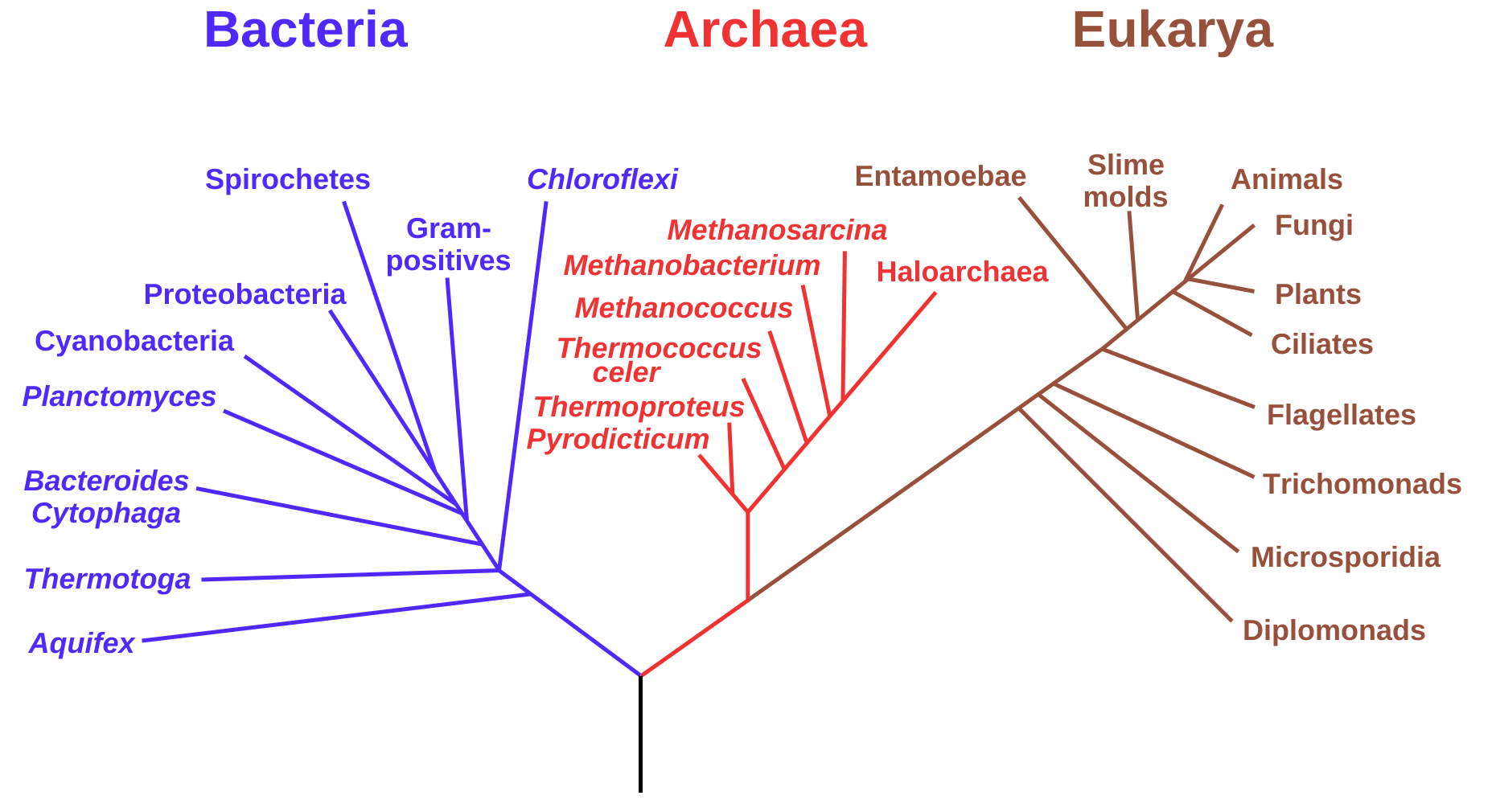 Diagram of a contemporary tree of life based on cladistics, separating life into three top-level domains and twenty-five kingdoms.
By 300 BCE, Greek philosophers were clearly dividing life between animals, studied in Plato’s Τῶν περὶ τὰ ζῷα ἱστοριῶν / Historia Animalium; and plants, studied in his student Theophrastus’s Περὶ φυτῶν ἱστορία / Historia Plantarum. Linnaeus originally proposed dividing all life into three top-level kingdoms in his 1735 Systema Naturale, which translate into the now-familiar “Animal, vegetable, or mineral?” While Twenty Questions was a well-known English parlor game by 1790, its iconic first question wasn’t typically included until the 1840s. The phrase was immortalized in Gilbert and Sullivan’s 1879 opera The Pirates of Penzance by its inclusion in “I Am the Very Model of a Modern Major-General”.
But by then, it was clear there was more to life than those three categories. A proposal to add protists (“primitive” microorganisms) as a top-level division was put forward in 1860, and in 1866 another proposal to remove minerals was submitted and accepted. In 1938, the newly-discovered distinction between prokaryotes and eukaryotes was reflected in four top-level divisions: animal, plant, protist, and monera (prokaryotes). The next eighty years of rapid discovery added more complexity than anyone anticipated. Today, we largely discard the idea of artificial top-level distinctions and let genetic similarity determine how things are categorized. If we had to pick seven second-level divisions roughly akin to those historical top-level divisions, we might propose animals, plants, protozoa, bacteria, archaea, fungi, and chromista. But as you can see in the phylogenetic tree above, those are kind of arbitrary choices.
In-N-Out Burger first added animal style to their secret menu in 1961, named after rowdy drive-thru customers the staff privately called “animals”.